Church of Saint-Michel
-
 Photo creditgoldObotLicenseFree Art License
-
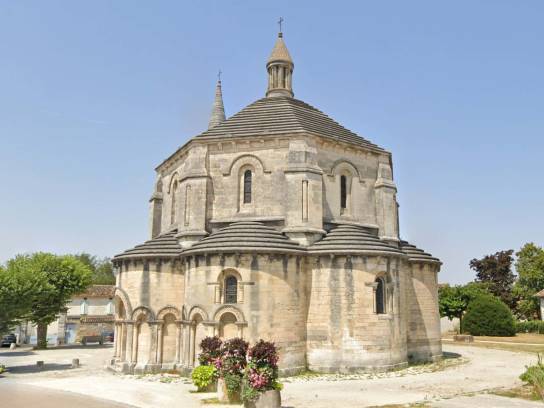 Photo creditgoldObotLicenseFree Art License
-
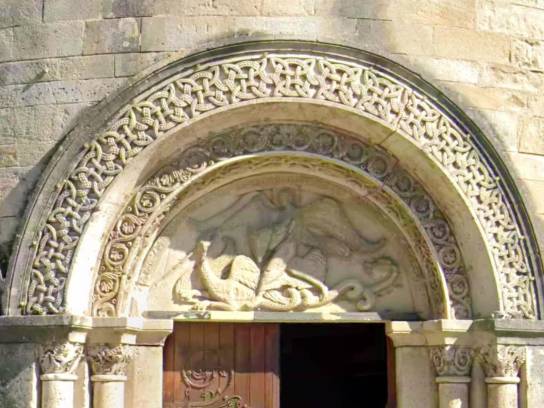 Photo creditgoldObotLicenseFree Art License
-
 Photo creditgoldObotLicenseFree Art License
-
 Photo creditgoldObotLicenseFree Art License


About
The Church of Saint-Michel in Entraygues is a Romanesque building notable for its octagonal plan, organised around a central space and eight apsidioles. Its construction is documented in 1137, on the initiative of the abbot of La Couronne.
The building has had an eventful history: following the collapse of its vault in the early 17th century, it underwent extensive restoration between 1848 and 1853 by Paul Abadie, an architect particularly active in the religious heritage of the Angoumois region.
The western portal features a particularly remarkable element: a Romanesque tympanum depicting Saint Michael slaying the dragon, dated to around 1137. The Cité de l’architecture et du patrimoine holds a cast of this tympanum.
Not to be missed
- The octagonal plan and the arrangement of the eight apsidioles.
- The portal’s tympanum, depicting Saint Michael slaying the dragon.
- The dome and the upper storey, extensively rebuilt during Paul Abadie’s restoration.
Discover
A Romanesque church with a distinctive layout
Saint-Michel d’Entraygues stands out immediately from other Romanesque churches in the Charente region due to its layout, centred on an octagonal rotunda. Eight apsidioles open out around this central space, giving the building a composition that is particularly clear when viewed from the inside.
This layout brings the church closer to certain Romanesque structures with a centralised plan. It is one of the key elements for understanding its architectural significance.
The church’s construction is attested to in 1137, a date known thanks to a document linked to La Couronne Abbey. The church subsequently became a parish church during the Middle Ages.
History
The building has undergone significant alterations over the centuries.
Following the turmoil of the Wars of Religion, the vault collapsed in the early 17th century. The church was then reduced to its lower level and given a temporary timber-framed roof, mentioned around 1644.
Its inclusion on the first list of Historic Monuments, in 1840, took place at a time when medieval buildings were receiving increasing attention from the authorities responsible for their conservation.
Between 1848 and 1853, Paul Abadie carried out a major restoration. The heritage documentation devoted to the architect also includes a drawing entitled ‘Church of Saint-Michel: Current condition and restoration’, dated February 1848.
Timeline
- 1137: Construction and consecration of the church, spearheaded by the Abbot of La Couronne.
- Early 17th century: Collapse of the vault, in the wake of the Wars of Religion.
- Around 1644: The building was covered with a simple roof structure following the collapse of the vault.
- 1840: The church was listed as a historic monument on the first national list.
- 1848–1853: A major restoration programme led by Paul Abadie.
- 1852: The church was reconsecrated following the restoration work.
- 1898: Construction of the first bell tower, separate from the church.
- Early 20th century: The bell tower was replaced by the one we see today.
Architecture and heritage
The most striking feature of the church is its centralised octagonal plan. The rotunda is surrounded by eight apsidioles, whilst powerful external buttresses support the structure.
The current dome, however, should be viewed with caution when attempting to reconstruct the exact appearance of the medieval church. Paul Abadie’s restoration profoundly altered the upper parts of the building. According to historical sources on the church, the architect notably created the upper storey with its tall windows and the eight-sided dome in a Romanesque style that does not necessarily correspond to the original elevation.
It is precisely this superimposition of preserved medieval architecture and 19th-century restoration that gives the church a particularly interesting architectural history.
The tympanum of Saint Michael
The western portal features a tympanum dedicated to the church’s patron saint. Saint Michael is depicted there slaying the dragon, in accordance with the iconography derived in particular from the Book of Revelation.
The Cité de l’architecture et du patrimoine dates the original work to around 1137. It also holds a cast of the tympanum, made in the 20th century.
One detail is worth noting: traces of red ochre remain on the ancient decoration, reminding us that Romanesque sculpture was not necessarily intended to remain entirely bare stone.
Paul Abadie, restorer of the church
The restoration of Saint-Michel forms part of the body of work by Paul Abadie, an architect born in 1812 with close ties to the Angoumois region. He served notably as diocesan architect for Angoulême, Périgueux and Cahors.
His work at Saint-Michel illustrates how 19th-century architects approached the restoration of Romanesque buildings at the time: it was not merely a matter of preserving the remains, but also of restoring architectural coherence, sometimes based on an interpretation of the medieval building.
Did you know?
The church is often presented as a building linked to pilgrimages to Santiago de Compostela. However, this tradition needs to be qualified: local sources indicate that an old misunderstanding may have associated the church with a former pilgrims’ inn situated opposite the building.
Explore
Guided tour
- Start at the gateway
Before entering, take a moment to look at the western gateway. The tympanum dedicated to Saint Michael is one of the oldest and most clearly legible examples of Romanesque architecture.
Look out for the figure of the archangel and the dragon. Also note the overall composition of the tympanum and the traces of polychromy that remain on the sculpture. - Enter the central space
Once inside, your first impression will be of the building’s geometry. Rather than following a long, traditional nave, your gaze is drawn towards the centre of the composition.
Count the eight apsidioles surrounding the rotunda.
This octagonal layout is the true guiding thread of the tour. - Look up
The current dome is one of the most visible features of the 19th-century restoration.
Observe the transition between the lower space and the dome, then the openings on the upper storey.
Bear in mind that this upper section is largely linked to the restoration work carried out by Paul Abadie between 1848 and 1853. - Look for traces of the Middle Ages
The tour becomes even more interesting when you can distinguish between the preserved Romanesque architecture and the 19th-century restorations.
The church is therefore not merely a 12th-century monument: it also bears witness to the way in which medieval heritage was understood and restored in the 19th century.
Then / Now
- Yesterday: a Romanesque church built in the 12th century, then radically altered following the collapse of its vault.
- Today: a listed monument since 1840, whose appearance combines medieval elements with a major intervention by Paul Abadie.
The comparison is particularly interesting in the case of the dome and the upper sections, which should not be regarded as an accurate reconstruction of the medieval state.
The hidden detail
The detail to look for is less an object than a trace: the remains of polychromy on the tympanum.
The presence of red ochre serves as a reminder that Romanesque sculpture could have been painted. The colour, now barely visible, alters our perception of a medieval sculpture that is now dominated by stone.
The bell tower
The bell tower stands separate from the church. An initial freestanding bell tower was built in 1898 before being replaced in the early 20th century.
Nearby
The church is situated in the heart of Saint-Michel, within the Angoulême urban area. It can be included as part of a wider exploration of the town’s heritage and the landscapes of the Charente valley.
For a coherent heritage tour, the church can serve as a starting point for exploring the connections between the village, the ancient routes and the Angoumois region.
Continue the tour
A more in-depth visit can be extended by researching Paul Abadie and the restoration of Charente’s Romanesque heritage. His work at Saint-Michel helps to situate the church within the broader history of 19th-century monument restoration.
The documentation held by the Heritage Media Library includes, in particular, drawings by Paul Abadie relating to the church of Saint-Michel, whilst the Musée des Monuments Français holds a cast of the tympanum.
Visit

Conditions of visits:
Opening hours
The church is open until 6.00 pm in summer.
Prices
Equipment and services
- Wheelchair-accessible entrance
- Wheelchair-accessible car park