Saint-Ausone Church
-
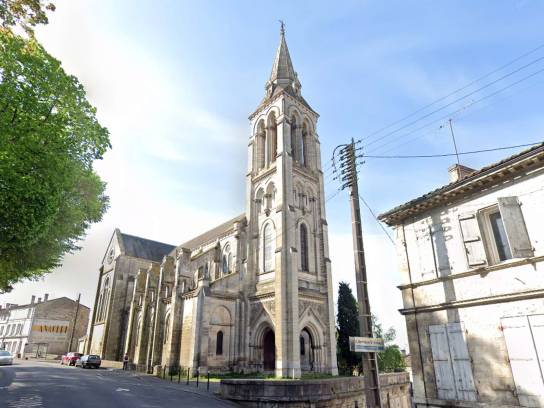 Photo creditgoldObotLicenseFree Art License
-
 Photo creditJack maLicenseCC BY-SA 3.0


About
The Church of Saint-Ausone is one of the major 19th-century religious buildings in Angoulême. Located at the foot of the historic plateau, in the Saint-Ausone neighborhood, it is closely linked to the legacy of the city's first bishop and to the history of the former Benedictine abbey that once stood on this site.
History
The current church was built between 1864 and 1869 by architect Paul Abadie, famous for restoring numerous monuments and later the architect of the Basilica of the Sacred Heart in Montmartre. It replaces an old parish church that had become too small and stands on the site of the former Saint-Ausone Abbey, whose buildings had been largely destroyed or converted after the French Revolution.
The church is dedicated to Saint-Ausone, traditionally regarded as the first bishop of Angoulême in the 4th century. According to this tradition, he was buried near this site, where a Benedictine abbey for women later developed and remained significant throughout the Middle Ages.
Architecture
The building is representative of the Neo-Gothic style popular during the Second Empire:
- an elongated layout with a nave flanked by side aisles;
- a bell tower-porch that dominates the western façade;
- tall pointed-arch windows and a vertical elevation characteristic of the Gothic style reinterpreted in the 19th century;
- masonry made of local limestone that blends into the urban landscape of Angoulême.
One of the best-known episodes in its construction concerns the bell tower spire. Paul Abadie had modified his initial design during construction to improve the building's proportions. However, the city council demanded a return to the original design, which led to the demolition of a section that had already been built. This decision explains the distinctive silhouette of the current spire, whose transition to its base appears relatively abrupt.
Artistic Heritage
The church notably houses:
- a carved wooden statue of Saint-Ausone, made of linden wood and classified as a historic monument since 1941;
- stained-glass windows and interior decoration characteristic of 19th-century religious architecture, highlighting the figure of the patron saint and local Christian history.
Heritage Significance
The Church of Saint-Ausone is significant for several reasons:
- it stands as an important testament to Paul Abadie's work in Angoulême;
- it preserves the memory of the former Saint-Ausone Abbey, of which the cloister and the chapel of the former seminary—now part of the diocesan heritage—remain;
- it exemplifies the revival of French religious architecture in the 19th century, marked by a return to medieval forms and the rise of the Neo-Gothic style.
In short, the Church of Saint-Ausone is a monument where the memory of Angoulême's Christian origins, 19th-century Neo-Gothic architecture, and the legacy of Paul Abadie—a major figure in French architecture—converge.
Visit
Conditions of visits:
Opening hours
Prices
Equipment and services
- Wheelchair-accessible car park