Saint-Cybard Church (Magnac-sur-Touvre)
-
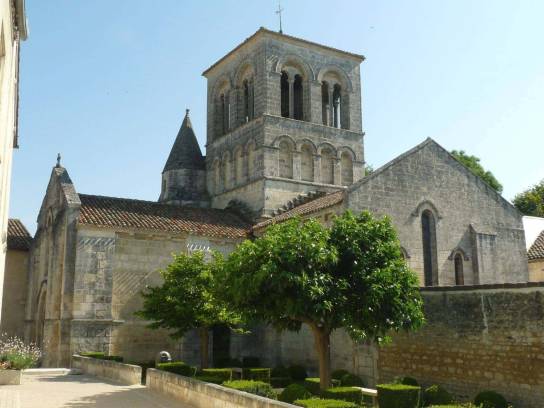 Photo creditJack maLicenseCC BY-SA 3.0
-
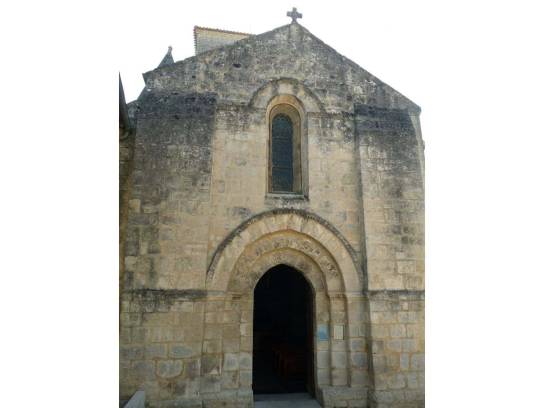 Photo creditJack maLicenseCC BY-SA 3.0
-
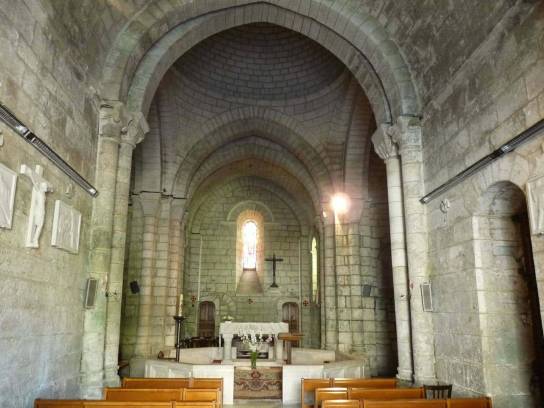 Photo creditJack maLicenseCC BY-SA 3.0


About
Saint-Cybard Church is notable first and foremost for its unusual layout: its four arms are of comparable length, forming a composition reminiscent of a Greek cross. The dome covering the crossing of the transept is not, however, positioned exactly in the centre. The square bell tower rises above this dome.
The building also features more recent décor that contrasts with its Romanesque architecture. Five stained-glass windows, created around 1930-1932 by the Limousin master glassmaker Francis Chigot, bring coloured light into the interior. Their design, characterised by simplified, geometric forms, reflects the Art Deco aesthetic.
A must-see
- The Greek cross plan, rare in the region and particularly evident from the interior.
- The dome supported by pendentives and the square bell tower, which define the central part of the building.
- The five stained-glass windows by Francis Chigot, created around 1930-1932.
Discover
Introduction
Built in the 12th century, the Church of Saint-Cybard forms part of the Romanesque heritage of the Angoumois region. Its main distinctive feature lies in its spatial layout: the building has a centred plan, almost in the shape of a Greek cross, a layout that is uncommon in the region. The Ministry of Culture describes four arms of equal length, whilst the dome does not occupy the exact geometric centre of the structure.
The church is situated in the heart of the village, in the immediate vicinity of the River Touvre. This relationship with the river contributes to the view of the monument from the outskirts of the village.
History
The present building dates mainly from the 12th century. It has been listed as a Historic Monument since 21 September 1907, a status that covers the church in its entirety.
In the early 20th century, the church underwent a major restoration and embellishment programme carried out with the assistance of Father Lescuras. This work helped to preserve the building, which was then in danger of falling into ruin.
This project also saw the renewal of part of the interior décor. The stained-glass windows, created around 1930–1932 by Francis Chigot, introduced a 20th-century artistic style into the Romanesque building.
Timeline
- 12th century - Construction: The church was built in the Romanesque architectural style. Its design is characterised by a centralised plan resembling a Greek cross.
- 1907 - Listing: Saint-Cybard Church was listed as a Historic Monument by decree of 21 September.
- Early 20th century - Restoration: A major restoration and embellishment programme was carried out under the leadership of Father Lescuras.
- Around 1930–1932 - The stained-glass windows: The Limousin master glassmaker Francis Chigot created five stained-glass windows depicting historical scenes for the church.
Architecture and heritage
The architecture of Saint-Cybard is worth noting for the balance it strikes between its various volumes.
The nave comprises two bays. It is flanked by a projecting transept, the arms of which house chapels. Above the crossing rises a dome supported by pendentives.
The square bell tower, situated above the dome, forms the monument’s principal vertical feature. It comprises two storeys featuring twin-arched windows.
Externally, the church’s compact form makes it fairly easy to grasp the logic of the plan. The Ministry of Culture notably highlights a flat chevet and provides several views of the building from its various sides.
The stained-glass windows by Francis Chigot
The stained-glass decoration is one of the church’s main points of contrast.
The five stained-glass windows depicting historical scenes were created around 1930–1932 by Francis Chigot, a master glassmaker from Limousin. Their composition combines figures depicted in very frontal poses with simplified, geometric forms. The ensemble is rooted in the Art Deco aesthetic, with visual references to Byzantine art.
The leadwork itself contributes to the design: in particular, it follows the drapery of the figures.
Did you know?
The layout of Saint-Cybard is particularly unusual: the four arms of the church are of equal length, but the dome is not positioned exactly in the centre. This distinctive feature is explicitly noted in the Ministry of Culture’s description.
Explore
Guided tour
- Start at the forecourt
Take a few moments to look at the building as a whole before going inside. From the outside, try to understand how the bell tower dominates the lower parts of the church. - Look at the floor plan
Once inside, observe how the nave, transept and side aisles are arranged around the central section. The almost centralised nature of the layout is more clearly apparent from the inside. - Look up at the dome
The dome forms the architectural heart of the church. It rests on pendentives and directly supports the bell tower. - Look for the five stained-glass windows
Take the time to compare the compositions: the figures, drapery, lead lines and geometric shapes reflect an aesthetic very different from that of Romanesque architecture. - Observe the bell tower from the outside
The square, two-storey bell tower and its twin-arched windows are one of the most distinctive features of the silhouette of Saint-Cybard’s Church.
Look here
- In the centre: the dome and the way it fits into the almost Greek cross-shaped plan.
- Above: the proportions of the bell tower and, on the outside, its two levels of twin-arched windows.
- In the windows: the five stained-glass panels by Francis Chigot and their geometric design.
- In the details: note the graphic role of the lead came in the drapery of the figures. It is not merely used to join the glass together: it contributes to the composition’s design.
Then / Now
The church today retains its 12th-century Romanesque architecture whilst featuring 20th-century stained-glass decoration. This layering allows the monument to be interpreted as a building that has evolved over time rather than as a static structure. The restoration campaign of the early 20th century and the installation of the stained-glass windows around 1930–1932 represent two particularly significant stages in this evolution.
Hidden detail
The detail to look out for is not necessarily a single element, but a relationship between several volumes: the dome is not exactly at the centre of the plan, despite the almost regular Greek cross layout. Take the time to compare the different arms of the church from the inside to notice this distinctive feature, as highlighted in the official heritage description.
The church and the River Touvre
Saint-Cybard Church is situated on the left bank of the Touvre, in the heart of the village. Its location near the river contributes to the surrounding landscape and offers certain views of the bell tower from the riverbanks.
Nearby
- The banks of the Touvre, to continue exploring the monument’s natural surroundings.
- The wash house situated near the church.
- The village of Magnac-sur-Touvre, which is best explored on foot to see the church in its local context.
Continue the visit
After visiting the church, a stroll to the banks of the Touvre offers a change of perspective: having observed the scale and architectural details of Saint-Cybard, visitors can once again appreciate the relationship between the village, the river and the landscape.
Visit
Conditions of visits:
Opening hours
The church is open every day.
Prices
Equipment and services
- Wheelchair-accessible car park