Saint-Jacques de l'Houmeau Church
-
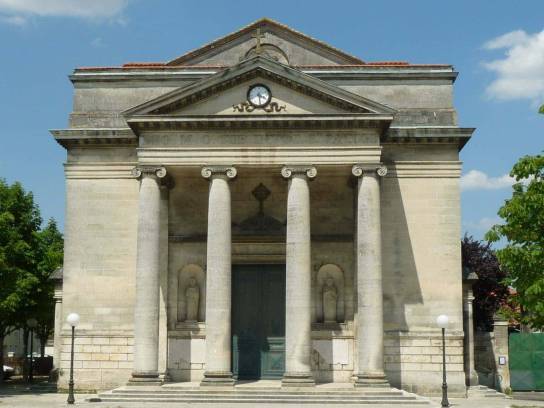 Photo creditJack maLicenseCC BY-SA 3.0
-
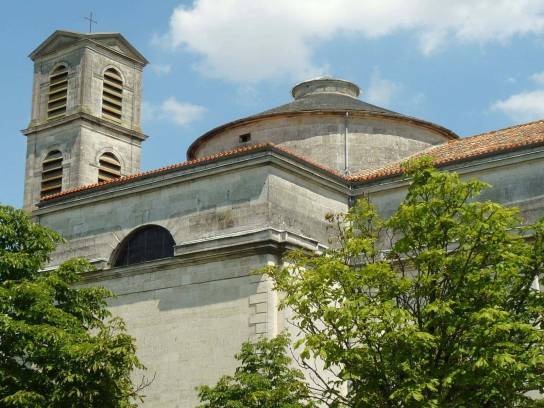 Photo creditJack maLicenseCC BY-SA 3.0
-
 Photo creditJack maLicenseCC BY-SA 3.0
-
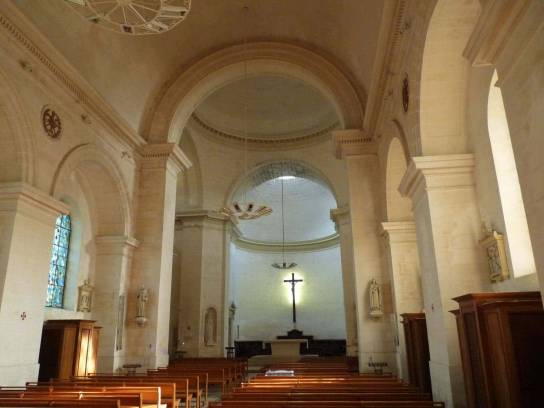 Photo creditJack maLicenseCC BY-SA 3.0
-
 Photo creditJack maLicenseCC BY-SA 3.0
-
 Photo creditJack maLicenseCC BY-SA 3.0
-
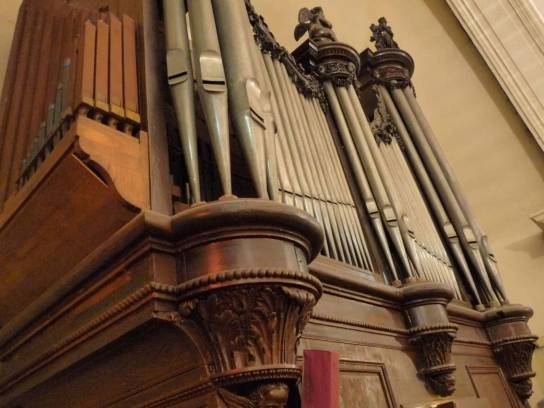 Photo creditJack maLicenseCC BY-SA 3.0
-
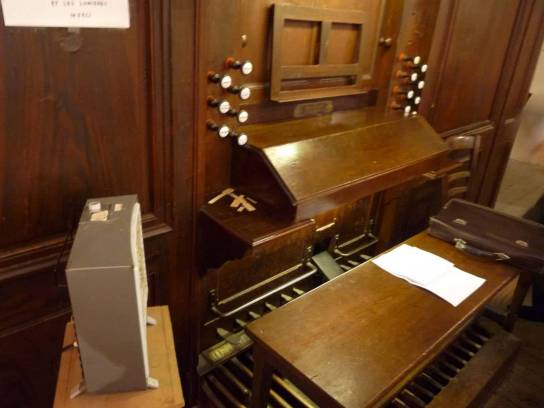 Photo creditJack maLicenseCC BY-SA 3.0


About
The Church of Saint-Jacques de l'Houmeau is one of the main religious buildings in the Houmeau suburb, a former port and industrial district located at the foot of the Angoulême plateau. It stands as a testament to the neighborhood's history, the pilgrimage to Santiago de Compostela, and 19th-century religious architecture.
History
The parish's origins date back to the early 12th century. The first church, under the jurisdiction of Saint-Cybard Abbey, is documented around 1110. At that time, the Houmeau neighborhood was located on a branch of the pilgrimage routes to Santiago de Compostela connecting the Périgord region to Saintes and Spain. The church's dedication to Saint James the Greater reflects this role as a place of welcome for pilgrims.
By the early 19th century, the medieval building had fallen into serious disrepair. Between 1840 and 1843, it was completely rebuilt under the direction of Paul Abadie Sr. (not to be confused with his son, the future architect of the Sacré-Cœur in Montmartre). The new building, however, retained the general layout of the old church in order to preserve parish traditions.
During the Allied bombings of 1944 targeting the railway facilities in Angoulême, the church sustained significant damage. Part of the painted decoration was lost forever. Restoration work continued between 1960 and 1963. Since September 19, 2001, the church has been listed as a Historic Monument.
Architecture
The church is representative of religious Neoclassicism from the first half of the 19th century.
Its main features are:
- a Latin cross plan;
- a single nave, inherited from the medieval building;
- a semicircular apse;
- a monumental portico preceded by a few steps;
- a façade with four Ionic columns supporting a triangular pediment, inspired by ancient temples;
- a rectangular bell tower attached to the apse, rising over several levels.
This understated architecture contrasts with the grand Romanesque churches of Angoulême, but clearly reflects the principles of order and symmetry sought by 19th-century architects.
Interior Decor
The interior was originally entirely decorated with murals, which have since been lost as a result of the destruction during World War II. The space, however, retains a great sense of simplicity, highlighting the natural light and the spaciousness of the nave.
A Remarkable Organ
One of the church's major heritage features is its organ.
- Built in 1787 by organ builder Schwaerdt for the Benedictine convent of Saint-Ausone;
- it was moved to Saint-Jacques in 1803 after the Revolution;
- restored in 1847;
- expanded by Aristide Cavaillé-Coll in 1892;
- it survived the bombings of 1944;
- restored once again and re-inaugurated in 2024.
This instrument is one of the most fascinating examples of organ building in the Charente region.
Heritage and Contemporary Life
Beyond its architectural significance, the church is a major urban landmark in the Houmeau neighborhood. Situated on a central square, it serves as a reminder of this suburb's historical role linked to Angoulême's river port, commerce, and industrial activities.
Since 2020, the Diocese of Angoulême has entrusted the church to the community of the Oratory of Saint Philip Neri, which is scheduled to take up permanent residence there once restoration work on the annex buildings is complete.
The Church of Saint-Jacques de l'Houmeau is of heritage interest for several reasons:
- historically, due to its medieval origins linked to the pilgrimage routes to Santiago de Compostela;
- architecturally, as an example of a neoclassical church from the first half of the 19th century;
- artistic, thanks to its historic 18th-century organ, enhanced by Cavaillé-Coll;
- as a memorial, preserving traces of the destruction and postwar reconstruction;
- urban, as it remains the symbolic heart of the Houmeau neighborhood.
Entry from the Mérimée database (architectural heritage): PA16000017

Visit
Conditions of visits:
Opening hours
Prices
Equipment and services
- Wheelchair-accessible entrance
- Wheelchair-accessible car park