Roc-de-Sers
-
 Photo creditJack maLicenseCC BY-SA 3.0
-
 Photo creditJack maLicenseCC BY-SA 3.0
-
 Photo creditJack maLicenseCC BY-SA 3.0
-
 Photo creditJack maLicenseCC BY-SA 3.0
-
 Photo creditJack maLicenseCC BY-SA 3.0
-
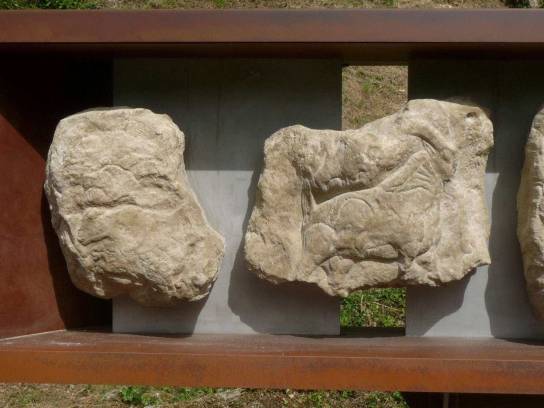 Photo creditJack maLicenseCC BY-SA 3.0
-
 Photo creditJack maLicenseCC BY-SA 3.0
-
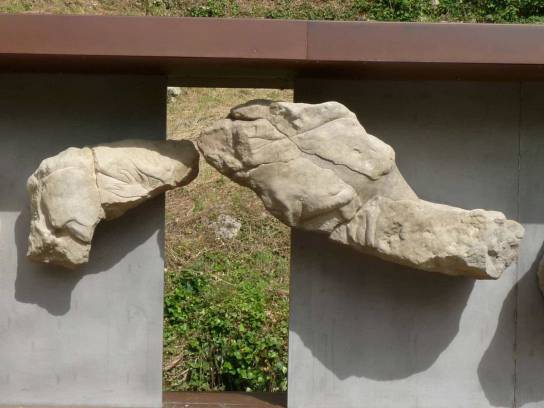 Photo creditJack maLicenseCC BY-SA 3.0
-
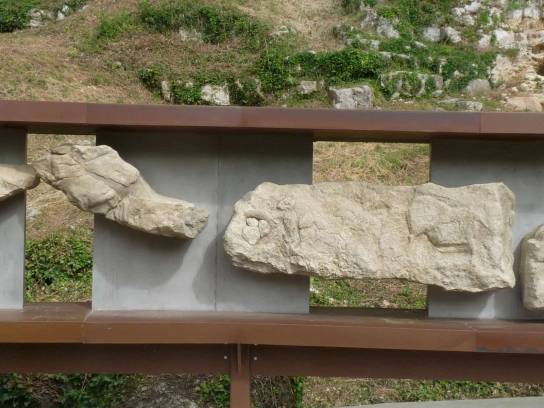 Photo creditJack maLicenseCC BY-SA 3.0
-
 Photo creditJack maLicenseCC BY-SA 3.0
-
 Photo creditJack maLicenseCC BY-SA 3.0


About
The Roc-de-Sers is a group of rock-shelter sites and caves situated in the Roc Valley, in the municipality of Sers. The site is particularly notable for the remains of a frieze carved into the limestone by the Solutrean people some 23,000 years ago.
Excavations have also yielded a significant flint artefact collection, notably laurel-leaf flakes and notched points, as well as engraved limestone slabs. Archaeological research was particularly advanced by the prehistorian Léon Henri-Martin in the early 20th century.
The original frieze, comprising several carved blocks, is now housed at the National Archaeology Museum. On site, an interpretative display helps visitors understand the layout of the ensemble and view a reconstruction of it.
A must-see
- The reconstruction of the carved frieze, with its depictions of animals and humans.
- The rock face and rock-shelter sites, which help visitors understand the link between habitation and artistic expression.
- The interpretative trail, located at the end of the access path.
Discover
A site occupied during the Upper Palaeolithic
Roc-de-Sers forms part of the group of prehistoric sites in the Roc Valley. The rock shelters and caves were inhabited during the Upper Palaeolithic and have yielded various artefacts attesting to human presence.
The Solutrean culture is particularly well represented. This Upper Palaeolithic culture is notably characterised here by flint tools such as laurel-leaf blades and notched points. A dating of burnt bone to 19,230 ± 300 years BP confirms that some of the remains date from this period.
The significance of Roc-de-Sers lies primarily in the association between settlement and sculpted art. The sculptures are therefore not separated from the everyday context of the human groups who occupied the rock-shelter sites. This association constitutes an important aspect of the site’s archaeological value.
History of the research
The first archaeological investigations began in the early 20th century. The most significant work was subsequently carried out by Léon Henri-Martin, particularly between 1909 and 1929. Further investigations were conducted in 1951 by Germaine Henri-Martin and Raymond Lantier.
The research has made it possible to identify a significant prehistoric settlement and to gain a better understanding of the carved blocks from the rock-shelter’s wall.
Chronology
- Upper Palaeolithic, around 23,000 years before the present: Solutrean occupation and the creation of carvings.
- Early 20th century: first archaeological investigations at the site.
- 1909-1929: major excavation campaigns led by Léon Henri-Martin.
- 1951: further excavations which helped to confirm the existence of a carved rock face still in situ.
- 20 July 1979: the site was listed as a historic monument.
- 2014-2015: completion and opening of the visitor centre.
Architecture and heritage
Here, the architecture is primarily geological and archaeological. The site is organised around a limestone cliff and several caves and rock shelters.
The carved rock face is the site’s most significant heritage feature. Limestone blocks resulting from its collapse have been recovered and studied. By piecing them together, it has been possible to reconstruct a frieze approximately ten metres long.
The carvings depict animals, including ibex, as well as human figures. The National Archaeology Museum holds several original blocks, including the famous block depicting ‘facing ibex’ and the block showing the ‘hunter being hunted’.
Did you know?
The Roc-de-Sers is associated with one of the oldest known carved cave friezes. The original blocks can weigh several hundred kilograms and are now housed at the National Archaeology Museum.
Explore
Guided tour
- Follow the path towards the Roc Valley
The site is accessible via a shaded path approximately 670 metres long. This gradual approach allows you to transition from the present-day landscape to the natural setting in which the prehistoric rock shelters were occupied. - Observe the cliff and the rock-shelter
Before looking for the carvings, take a moment to observe the relationship between the rock, the cavities and the sheltered spaces beneath the cliff. - Look at the reconstruction of the frieze
It helps you understand the arrangement of the carvings and their relationship with the rock face. - Look for the carved animals
The animal depictions are essential to understanding the richness of this art. Ibex are among the best-known figures at Roc-de-Sers. - Look for traces of the contemporary interpretation
The viewing platform and exhibition design explain the archaeological discoveries without replacing the original remains, which have been preserved for their protection. The interpretation area was opened to the public in 2015.
Look here
The relationship between the carvings and the settlement.
The key point is not merely the quality of the carvings: it is their presence in a space also occupied by human groups. Roc-de-Sers thus offers an insight into Palaeolithic art within its archaeological context.
Yesterday / Today
- Yesterday: a limestone cliff face carved by Solutrean people, within a rock-shelter settlement.
- Today: the original blocks are housed at the National Archaeology Museum, whilst the Sers site features a reconstruction and an interpretative trail.
The hidden detail
Look out for the facing ibexes. This motif is particularly characteristic of the Roc-de-Sers carvings and illustrates the level of skill achieved by the Solutrean artists. One of the blocks preserved at the National Archaeology Museum specifically depicts two facing ibexes.
The site and its surroundings
Roc-de-Sers lies within the Roc Valley, in a wooded area that now lines the access path. It can be explored as an archaeological site, but also as a gateway to the valley’s landscape.
Roc-de-Sers is also part of a wider network of prehistoric art sites in the Charente region, notably the Grotte du Placard and the Chaire-à-Calvin.
Nearby
To extend your exploration of prehistory in Sers, Le Préhisto-Sers, a small museum in the village, offers a general overview of prehistoric chronology and can serve as a useful complement to a visit to the Roc-de-Sers.
Extend your visit
A visit to the Roc-de-Sers is best extended by exploring other prehistoric sites in the Charente. A comparison with the Chaire-à-Calvin, in Mouthiers-sur-Boëme, in particular, offers an insight into another form of Palaeolithic sculpture.
Visit

Conditions of visits:
Opening hours
Prices
Equipment and services
- Wheelchair-accessible entrance
- Wheelchair-accessible car park
- Free parking