Soyaux Heaths
-
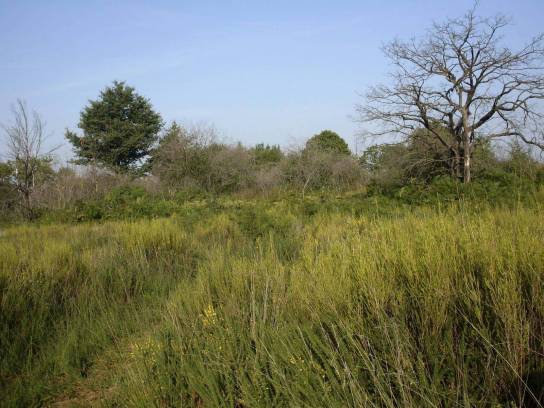 Photo creditTraumruneLicenseCC BY-SA 3.0

About
In the heart of the Pays d’Angoulême, the Soyaux Heaths form a vast area of heathland covering around 70 hectares. The site is the largest expanse of heathland in the Charente department and provides a particularly unique habitat within the urban area.
The acidic, sandy and clayey soils contrast with the predominantly limestone terrain around Angoulême. They support the growth of heathland vegetation, comprising mainly heather, gorse and broom. The landscape also bears traces of the site’s former uses, notably sheep farming and its use by the military as a training ground.
Discover
Landscapes and natural habitats
The landscape of Soyaux Heaths is dominated by open, shrubby heathland, where heather, gorse and broom can form vegetation ranging from several tens of centimeters to a few meters in height.
The site also features wooded areas of oak and chestnut. In its northern part, small limestone cliffs are home to shorter vegetation, whilst the central part is characterised by heather heathland.
Maintaining these open spaces requires regular management. Grazing, mowing and brush-clearing help prevent the heathland from gradually becoming overgrown with shrubs and trees.
Flora and fauna
Vegetation
The heaths are home to, amongst other things:
- various species of heather;
- broom heather, known locally as ‘brande’;
- gorse;
- broom;
- oaks and chestnut trees in the wooded areas.
Birds
The site is of particular interest for birds associated with heathland habitats, notably:
- the Montagu’s harrier;
- the European nightjar;
- the Cetti’s warbler.
Maintaining an open habitat also helps to support several species of bat.
Ecological and heritage value
The Soyaux Heaths benefit from several recognition and protection schemes.
The site is covered by a prefectural biotope protection order (APPB) and forms part of a ZNIEFF. It is also designated as a Sensitive Natural Area (ENS) by the Charente Department, and its management is overseen by the Nouvelle-Aquitaine Conservatory of Natural Areas.
Its significance lies in particular in the regional rarity of heathland and in the animal and plant species associated with these open habitats. Ecological management is specifically aimed at conserving this mosaic of habitats.
Explore
Things to see and observe
When exploring the heaths, you can see, amongst other things:
- expanses of heather-covered moorland;
- gorse and broom;
- wooded areas of oak and chestnut trees;
- traces of former military use;
- birds typical of heathland;
- the different types of vegetation resulting from land management.
Discover the site
Since 2026, the heaths have a new audio-illustrated nature trail. The route is marked by 12 educational signposts dedicated to the site’s ecology, its management and its historical uses. The audio clips are triggered via QR codes and feature, amongst other things, the song of the Eurasian warbler.
The trail starts at the welcome sign in the car park of the heaths leisure area, near the roundabout. After crossing the RD 939 via the safe crossing, access to the site is via a wooden gate; you should then follow the ‘Fauvette’ signs.
Please note the difference from the nature site: the former interpretive trail was a loop of approximately 5 km / 2 hours, with a possible shortcut of 4.5 km.
Best times to visit
Spring is a good time to observe the reawakening of the vegetation and the activity of the wildlife. Late summer and early autumn also offer the chance to enjoy the heathland landscapes and their changing colours.
Particular attention should be paid to the hunting season. The site may be closed to visitors on days when driven hunts take place, particularly during the hunting season from late August to February. The signs at the site entrances should be followed.
Conservation and best practice
- Please observe the signs and any temporary access restrictions.
- Do not enter the site on days when driven hunts are taking place.
- Stay on the authorised areas and paths.
- Do not pick plants or damage habitats.
- Do not disturb birds or other animals.
- Do not leave any litter behind.
- Motorised vehicles are prohibited on the site.
Practical information
- Address / access: Les Brandes leisure area, near the RD 939, Soyaux.
- Road access: from Angoulême, head towards the Effamiers roundabout, then follow the RD 939 towards Périgueux.
- Parking: car park at the Heaths visitor centre, near the roundabout.
- Starting point of the trail: information sign located in the car park.
- Crossing: access to the site via a designated and secure crossing over the RD 939.
- Accessibility for people with reduced mobility: not suitable for wheelchairs; the terrain is also unsuitable for pushchairs.
- Footwear: wear suitable footwear as some sections are uneven.
- Facilities: information boards and interpretive displays.
- Audio tour: a smartphone is required to use the QR codes and geolocated audio clips; geolocation must be enabled for automatic playback.
- Hunting: temporary restrictions may apply; please check the signage at the entrance before visiting.