Painted wall: "Kalis"
-
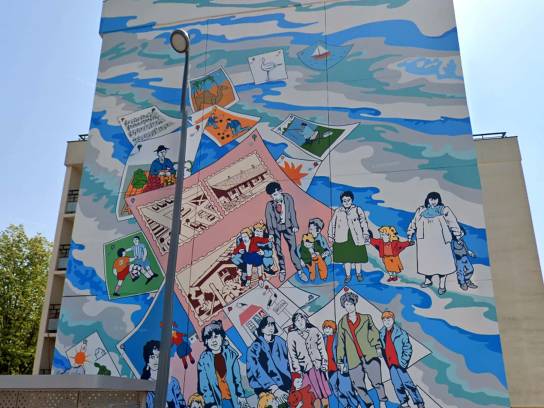 Photo creditGoogle streetLicenseAll rights reserved

About
The ‘Kalis’ mural, created in 1986 by Gérard Tisserand on a building in the Basseau district of Angoulême, is unique in the history of Angoulême’s murals as it does not depict a comic-strip character. It predates the great wave of comic-strip murals that brought the city to prominence from the late 1990s onwards. It belongs to a first generation of murals intended to transform the living environment and give a strong visual identity to a neighbourhood undergoing regeneration.
Its history is closely linked to that of Basseau, a neighbourhood that has undergone profound changes. Formerly an industrial and working-class area, Basseau developed around the industries of the Charente Valley. Following the closure of several industrial sites and urban regeneration projects, the neighbourhood had to rebuild its identity.
In this context, the “Kalis” mural was not conceived as a tourist attraction. The aim was to introduce a monumental work of art into the daily lives of local residents, to transform a large building gable into a visual landmark, and to demonstrate that art could find its place in a working-class neighbourhood. This approach was quite innovative in the mid-1980s.
Its significance is above all symbolic and urban:
- Enhancing the neighbourhood: the mural was created to beautify an area characterised by large housing estates and to provide a cultural focal point for local residents.
- To foster a sense of belonging: unlike more recent murals dedicated to comic books, ‘Kalis’ is a work designed for the neighbourhood’s residents rather than as a tourist attraction.
- Playing with abstraction and colour: the artist Gérard Tisserand favours stylised forms and bright colours. The work does not tell a specific story; rather, it invites personal interpretation, centred on themes such as movement, energy and community life.
- The title ‘Kalis’ itself has not been the subject of any known official explanation. Available sources do not attribute any specific meaning to it, which reinforces the work’s open-ended and poetic nature.
The choice of Gérard Tisserand is no coincidence. Having taught in Angoulême for many years, he was a leading figure in Narrative Figuration, an artistic movement that sought to make art accessible whilst offering a critical perspective on society. His work emphasised powerful imagery, colour and the presence of art in public spaces rather than solely in museums.
Over time, the “Kalis” mural has become a symbol of the neighbourhood for several reasons:
- it is one of the oldest large-scale monumental murals in Angoulême;
- several generations of residents have grown up with this work as a landmark;
- it recalls a period when people sought to improve their living environment through artistic creation, even before comic-strip murals became the hallmark of Angoulême.
Even today, when people talk about Angoulême’s painted walls, “Kalis” is often cited as a forerunner. It represents another facet of the city’s identity: not just the capital of comics, but also a city where public art has served to enrich neighbourhood life and create a collective memory.