Bust of Raoul Verlet
-
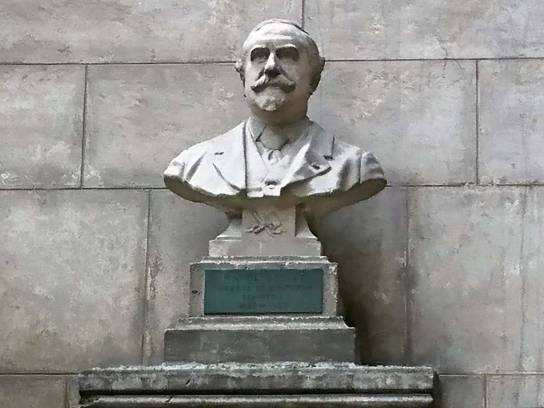 Photo creditgoldObot

About
The bust of Raoul Verlet, located in the courtyard of Angoulême City Hall, is a piece of small-scale urban heritage that pays tribute to one of the most important sculptors from the Charente region of the late 19th and early 20th centuries. It is part of the city’s heritage trail, alongside the busts of Paul Abadie, Hergé, and other prominent figures in Angoulême’s history.
History
Raoul Charles Verlet (1857–1923) was born in Angoulême. The son of Alexandre Verlet, a funeral monument contractor and caretaker of the Bardines Cemetery, he developed an interest in sculpture at a very early age. Recommended by the architect Paul Abadie, he continued his training at the École des Beaux-Arts in Paris under Jules Cavelier and Louis-Ernest Barrias. As the winner of the second Grand Prix de Rome in 1883, he quickly gained national renown. Beginning in 1905, he taught at the École nationale supérieure des Beaux-Arts and became a member of the Institut de France in 1910.
The bust installed in Angoulême is not a work created by Raoul Verlet, but a commemorative monument intended to highlight the sculptor’s significant place in the local artistic heritage. Its placement in front of City Hall underscores the city’s commitment to honoring the prominent figures who have shaped the city’s history.
Architecture and Artistic Features
The monument features a classical composition:
- a stone bust, depicting Raoul Verlet in a realistic style (it is a copy made by overmolding the original plaster cast, as the original bronze piece was melted down);
- a limestone pedestal, a material emblematic of Angoumois architecture;
- a sober presentation that emphasizes the dignity of the portrait rather than monumental decoration.
This simplicity is characteristic of 20th-century honorary monuments. The rendering of the face highlights the portraiture skills in which Raoul Verlet himself excelled in his numerous commissions for official busts.
Heritage Value
The bust holds several levels of heritage significance:
- historical, as it commemorates the career of an artist born in Angoulême who became one of the most renowned French sculptors of his time;
- artistic, as it underscores the importance of monumental sculpture in public spaces;
- urban, as it contributes to the composition of the Place de l’Hôtel de Ville, where several monuments dedicated to prominent local figures are located;
- in terms of identity, as it illustrates the city’s attachment to its artists and its cultural heritage.
Raoul Verlet and Angoulême’s Heritage
The bust takes on its full meaning when viewed within the context of the body of work that Raoul Verlet left behind in Angoulême, notably:
- the Monument to Sadi Carnot (1897), on the Desaix rampart;
- several remarkable funerary sculptures at the Bardines Cemetery, some of which are now considered masterpieces of French funerary sculpture;
- various decorative works in the local heritage.
Current Heritage Value
Today, the bust of Raoul Verlet serves as a memorial landmark in the heart of Angoulême. Although modest in size, it helps highlight the city’s artistic heritage by serving as a reminder that Angoulême was the birthplace of a sculptor whose works are housed in several French museums and who had a profound influence on public sculpture during the Third Republic.
Visit
Conditions de visites
Opening hours
Prices
Localization
Buste de Raoul Verlet
Buste de Raoul Verlet
Hôtel de ville, 1 place de l'Hôtel de ville
16000 Angoulême