Saint Hilaire Church
-
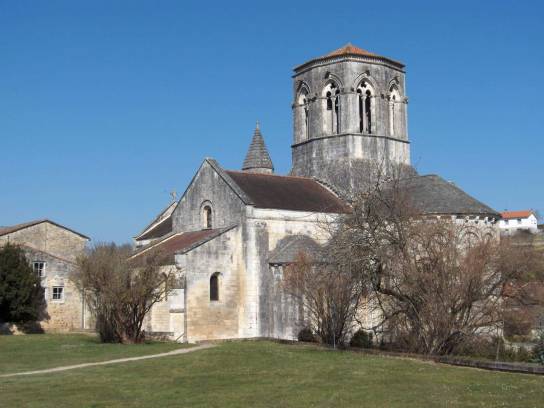 Photo credit2PassageLicenseCC BY-SA 3.0
-
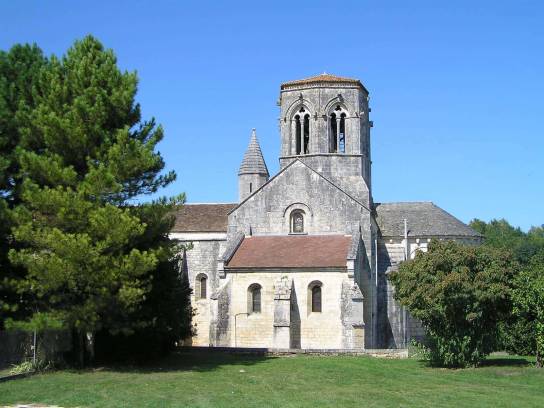 Photo creditRosierLicenseCC BY-SA 3.0
-
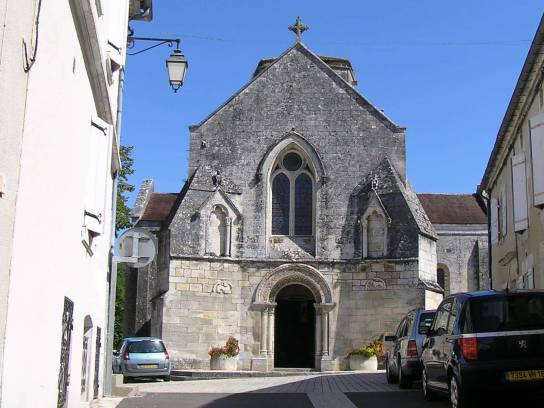 Photo creditRosierLicenseCC BY-SA 3.0
-
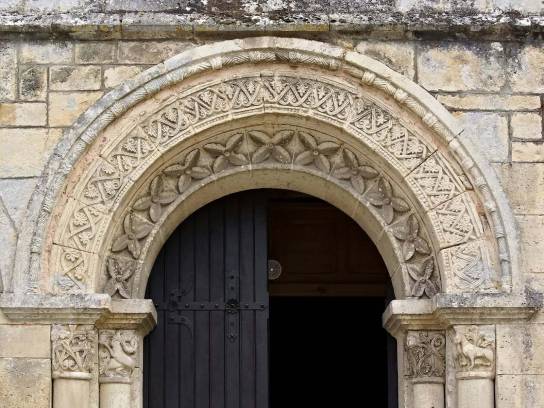 Photo creditJLPCLicenseCC BY-SA 3.0
-
 Photo creditJLPCLicenseCC BY-SA 3.0


About
The Church of Saint-Hilaire stands at the heart of the village of Mouthiers-sur-Boëme, near the River Boëme. Its history is linked to the former priory founded in the 11th century by the Benedictine Abbey of Saint-Martial in Limoges. The present building retains a significant Romanesque structure, which has been altered over the centuries.
The single nave, the semicircular apse and the transept bear witness to the layout of the medieval church. The 13th-century Gothic bell tower, featuring trefoil arches, is one of its most recognisable architectural features.
A must-see
- The 13th-century Gothic bell tower, featuring trefoil arches.
- The semicircular apse, lit by seven windows.
- The fragment of a sarcophagus reused in the south wall of the nave.
Discover
Introduction
Saint-Hilaire was originally a church associated with a Benedictine priory. In the 11th century, Saint-Martial Abbey in Limoges established a priory at Mouthiers-sur-Boëme, whose church served both as a priory church and a parish church. The development of the priory contributed to the formation of the medieval market town.
The building we see today, however, is the result of several phases of construction and alteration. The Romanesque base was extended and modified, notably in the 13th and 15th centuries. This layering allows us to trace several stages in the architectural history of the monument.
History
Local tradition attributes a very ancient origin to the church, which is said to have been founded before the year 1000 by Saints Cosmas and Damian. This tradition should not be confused with historically established facts: heritage sources date the main medieval construction phase to the 12th and 13th centuries.
Restoration work in the 19th century notably revealed remains of the original apse and certain ancient elements of the nave. The building has been listed as a Historic Monument since 1862, a status that covers the entire church.
Chronology
- 11th century: foundation of a priory at Mouthiers-sur-Boëme by the Benedictine Abbey of Saint-Martial in Limoges.
- 12th century: development of the medieval church and establishment of the Romanesque structure.
- 13th century: the Gothic bell tower was built and the façade underwent alterations.
- 15th century: further work altered the complex, notably with the construction of a rib-vaulted sacristy.
- 19th century: restoration work revealed several remains of the original building.
- 1862: Saint-Hilaire Church was listed as a Historic Monument.
Architecture & Heritage
The original church features a layout characteristic of Romanesque architecture: a single nave covered by a barrel vault supported by transverse ribs, extended by a semicircular apse. The transept opens onto apsidioles.
The apse benefits from particularly clear natural light thanks to its seven windows. The bell tower provides a contrast to this Romanesque architecture: its Gothic features and trefoil arches are typical of the 13th century.
The façade was also remodelled in the Middle Ages, whilst a sacristy with ribbed vaults was added in the 15th century. The monument’s significance therefore lies as much in its Romanesque features as in the alterations that allow us to trace its development.
Notable works and features
The sarcophagus fragment
In the nave, a fragment of an ancient or medieval sarcophagus has been reused in the south wall. This unobtrusive detail is a reminder of the common practice of reusing old materials in medieval buildings.
The apse
Take the time to observe the semicircular apse and the arrangement of its seven windows. It is one of the most characteristic features of Romanesque church design.
The bell tower
The 13th-century Gothic bell tower is distinguished by its trefoil-arched openings. Its verticality contrasts with the more massive forms of the Romanesque church.
Did you know?
The name Mouthiers-sur-Boëme is linked to the former monastic settlement in the village. The term ‘moustier’, derived from the Latin ‘monasterium’, refers to a monastery or religious establishment.
Explore
Guided tour
- Start outside
From Place de l’Abbé Joly, take in the church within its urban setting. The proximity of the Boëme river evokes the historic character of the market town, situated in a valley where the priory played a pivotal role. - Look up at the bell tower
Notice the trefoil arches that adorn the bell tower. They make it easier to identify the 13th-century Gothic style. - Enter the nave
Observe the single nave and its barrel vault supported by transverse ribs. Its simplicity helps to illustrate the layout of a Romanesque church. - Approach the chancel
The semicircular apse and its seven windows provide a good vantage point from which to understand the layout of the medieval building. - Look for the reused stone
In the south wall of the nave, look for the fragment of a sarcophagus reused in the masonry. It is one of the details most easily missed during a quick visit.
Look here
- The bell tower: look for the trefoil arches and compare their design with the simpler forms of the Romanesque sections.
- The nave: note the regularity of the structure and the way the transverse ribs give rhythm to the vault.
- The apse: count the seven windows that light this part of the church.
- The south wall: look out for the reused fragment of a sarcophagus.
Yesterday / Today
The 19th-century restorations helped to reveal elements of the original church, notably the remains of the original apse. The present building is therefore the result of a long evolution rather than a structure built in a single phase.
Hidden detail
The fragment of a sarcophagus incorporated into the south wall is a good example of a heritage detail that is easily overlooked by visitors. It deserves careful observation rather than simply being spotted from the entrance.
The church in its setting
Saint-Hilaire Church is situated in the historic centre of Mouthiers-sur-Boëme, a village characterised by the presence of the River Boëme and the former Benedictine monastery. A visit to the church can be combined with a stroll through the village centre and an exploration of the commune’s other heritage sites.
Nearby
To be completed depending on the chosen route around Mouthiers-sur-Boëme. The village boasts several buildings and sites listed as Historic Monuments, including the Château de la Foy, the Logis de Forge, the Chaire-à-Calvin and the prehistoric fortification at Camp aux Anglais.
Continue the tour
To extend your exploration, a trail dedicated to the heritage of Mouthiers-sur-Boëme allows you to connect the church with other traces of the area’s religious, rural and architectural history.
Visit
Conditions of visits:
Opening hours
- Sunday Mass: 9.30 am.
- Open until 6.00 pm in July and August.
- For groups, please enquire at the town hall or the Mouthiers-sur-Boëme Parish Association.
Prices
Equipment and services
- Wheelchair-accessible car park