Neptune Fountain
-
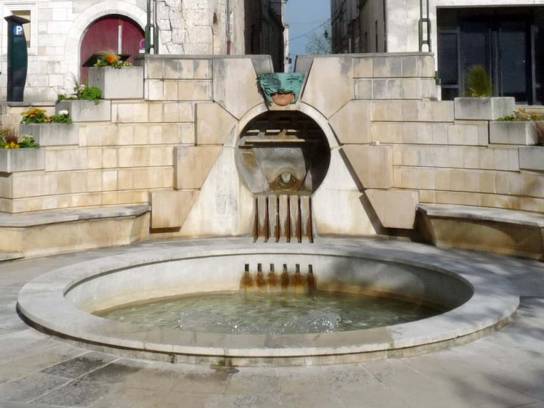 Photo creditJack maLicenseCC BY-SA 3.0

About
The Neptune Fountain is a part of Angoulême's local heritage, located on Place du Palet, in the heart of the old town. More than just a fountain, it serves as the focal point of an urban renewal project carried out in the late 20th century, aimed at revitalizing a historic area that had once fallen into disrepair.
History
Until the 1970s, Place du Palet was used primarily as a parking lot, which largely obscured its heritage value. As part of the policy to revitalize Angoulême's historic center, a major renovation program was launched between 1978 and 1986.
This project was entrusted to architect and urban planner Roland Castro, who set out to restructure the public spaces while highlighting the restored historic buildings as part of a planned housing improvement program (OPAH). The Neptune Fountain was inaugurated in April 1980, becoming one of the symbols of this urban renaissance.
Architecture
The project is not limited to the creation of a fountain. It is a true architectural composition organized on several levels that follows the steep slope characteristic of the Angoulême plateau:
- a small plaza for parking;
- a garden terrace crossed by a trellis covered in greenery;
- an open space for activities, gatherings, and public events.
The fountain occupies a central position in this arrangement of water and space. Its placement follows the changes in elevation and helps facilitate the transition between the different terraces.
The design favors understated materials—stone, vegetation, and water—to harmonize with the surrounding historic architecture rather than compete with it.
The Choice of Neptune
The name Neptune, the Roman god of the seas, springs, and waters, recalls the symbolic importance of water in the city of Angoulême.
Although the city is built on a promontory overlooking the Charente River, its history is intimately linked to water management: public fountains, wells, springs, and its proximity to the river have long shaped its development. The figure of Neptune thus evokes the mastery of water and its role in urban planning.
Heritage Significance
The Neptune Fountain holds several heritage values:
- it bears witness to the revitalization of Angoulême's historic center in the late 20th century;
- it illustrates architect Roland Castro's contribution to the restoration of the old quarter;
- it serves as an example of how a contemporary structure can be integrated into a medieval setting;
- it contributes to the scenic quality of Place du Palet by combining water, vegetation, and social spaces.
Things to Note on Site
During a visit, several features are worth noting:
- the terraced layout adapted to the natural topography;
- the relationship between the fountain and the restored historic buildings;
- the arbor and gardens that soften the hard, mineral landscape;
- the open views of the streets in the historic center;
- the fountain's discreet integration into an urban setting designed as a living space rather than as an isolated monument.
Today, the Neptune Fountain remains a successful example of urban renewal where historical heritage and contemporary design complement each other, illustrating the transformation of Angoulême's old town center at the end of the 20th century.