Place du Palet
-
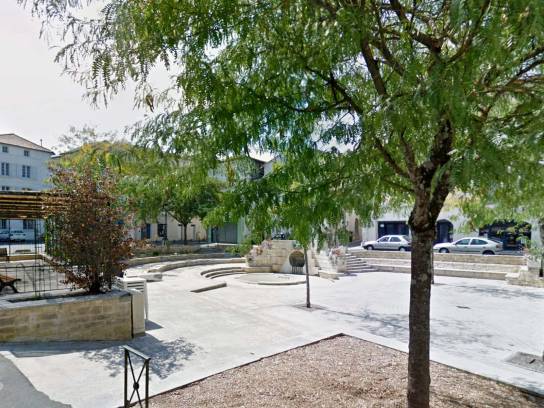 Photo creditgoldObotLicenseFree Art License

About
Place du Palet, located in Old Angoulême, is one of the city's oldest and most historically significant urban spaces. Its evolution reflects nearly a thousand years of urban, commercial, and architectural transformations.
A square that grew up around a medieval gate
In the Middle Ages, the square was located in front of the Porte du Palet, one of Angoulême's main fortified gateways. This gate, protected by a drawbridge, a barbican, and a defensive mound, controlled access to the city from the Abbey of Saint-Cybard and the Charente Valley.
The name "Palet” comes from the word "pal,” a post on which condemned prisoners were displayed or executed. Until 1349, a "pal” stood near the approach to the city; it was later replaced by a pillory, which remained a symbol of public justice until the 16th century.
The Grand Market of Angoulême
Starting in the 15th century, the square became the economic heart of the city.
Around 1450, a vast covered market hall made of wood and cob was built. Approximately 39 meters long and 15 meters wide, it occupied almost the entire square. It housed Angoulême's main market and even had a granary for storing wheat. For more than three centuries, all of the city's commercial activity revolved around this market hall.
In the 18th century, increased traffic made this complex very cumbersome. In 1777, the royal administration decided to demolish the market hall and move the market to another part of the city. The disappearance of this major facility gradually led to the commercial decline of the neighborhood.
19th-Century Transformations
With the gradual removal of the fortifications, the square opened up to the surrounding landscape.
On the site of the former gate, a semicircular belvedere overlooking the Charente Valley was created. The area was adorned with trees and a fountain, offering a veritable balcony overlooking the landscape. 19th-century plans show a more open square, organized around a central fountain and radiating paving patterns.
Roland Castro's Renovation
In the 20th century, the square was used primarily as a parking lot.
As part of the revitalization of Old Angoulême, the city commissioned architect Roland Castro to redesign the square between 1978 and 1986.
His design took advantage of the steep slope of the site and created a series of spaces:
- tiered terraces;
- circular ramps;
- a pergola covered with greenery;
- a circular fountain (known as the Neptune Fountain);
- plantings and gardens;
- meeting areas opening onto the ramparts and the valley.
This multi-level layout allows visitors to rediscover the historic vistas while creating a contemporary living space.
A New Chapter in the 21st Century
The square continues to undergo transformation today. In 2025, the City of Angoulême launched a project aimed at:
- make the upper section entirely pedestrian-only;
- expand the terraces of local businesses;
- increase greenery;
- limit vehicle traffic through access controls reserved primarily for deliveries.
Architectural Features
Today, Place du Palet is notable for:
- its location on the edge of the Angoulême plateau, offering views of the Charente Valley;
- its multi-level layout adapted to the natural slope;
- the interplay between medieval heritage, 1980s architecture, and contemporary landscaping;
- the presence of varied public spaces (terraces, gardens, bleachers, a fountain) that have replaced the former large covered market.
Place du Palet thus serves as an excellent example of the evolution of a French urban space: first a site of justice and defense in the Middle Ages, then the city's main market, and later a parking lot in the 20th century, it has become a heritage and landscaped public space that continues to be adapted to contemporary uses.