Statue of Marguerite d'Angoulême (Marguerite de Valois)
-
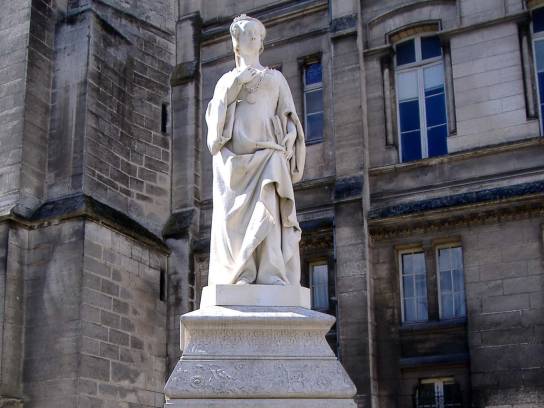 Photo creditHyppolyte de Saint-RambertLicenseCC BY-SA 4.0

About
The statue of Marguerite d'Angoulême, also known as Marguerite de Valois or Marguerite de Navarre, is one of Angoulême's most important historical monuments. Located in the gardens of City Hall, at the foot of the medieval tower traditionally considered her birthplace, it honors a major figure of the French Renaissance.
History
Marguerite d’Angoulême (1492–1549), the elder sister of Francis I, was Duchess of Alençon and later Queen of Navarre through her marriage to Henri II d’Albret. A woman of letters, patron of humanists, and author of the Heptaméron, she also played an important diplomatic and political role at the French court.
In the 19th century, amid a rediscovery of major national figures, the city of Angoulême decided to honor her. The sculptor Jacques Joseph Émile Badiou de la Tronchère created the statue in 1872. The government provided the block of marble, while the artist donated his work to the city. The monument was unveiled on May 11, 1877, during an official ceremony attended by local authorities and scholarly societies.
Sculpture
Carved from white marble, the statue reflects the academic style of the second half of the 19th century. Marguerite is depicted standing in a noble and serene pose, faithful to the idealized portrayal of great historical figures.
Notable features include:
- a royal crown, recalling her title as Queen of Navarre;
- a lavish Renaissance gown, rendered with particular attention to detail in its folds and embroidery;
- a cape inspired by Béarn traditional dress, evoking her kingdom of Navarre;
- a medallion worn on her chest, depicting her husband Henri II d’Albret as described in contemporary accounts.
The statue stands on a pedestal made of local limestone, designed by the municipal architect Varin. The base bears the dates 1492–1549, the intertwined initials of the Houses of Valois and Bourbon, and a commemorative inscription highlighting her historical significance.
A Monument That Is Part of Angoulême’s Heritage
The choice of its location is highly symbolic. The monument stands in the square in front of City Hall, at the foot of the former tower of the castle of the Counts of Angoulême, where tradition holds that Marguerite was born. This proximity reinforces the bond between the princess and her hometown.
Today, the statue is a major part of Angoulême’s heritage. It serves as a reminder of the intellectual influence of the Renaissance and the city’s attachment to one of its most illustrious figures. Beyond its artistic merit, it bears witness to the 19th-century policy of public monument construction, which sought to celebrate the great figures of national history through works installed in public spaces.
Opening hours
Prices
Localization
Statue de Marguerite d'Angoulême (Marguerite de Valois)
Statue de Marguerite d'Angoulême
Jardins de l'hôtel de ville,
16000 Angoulême