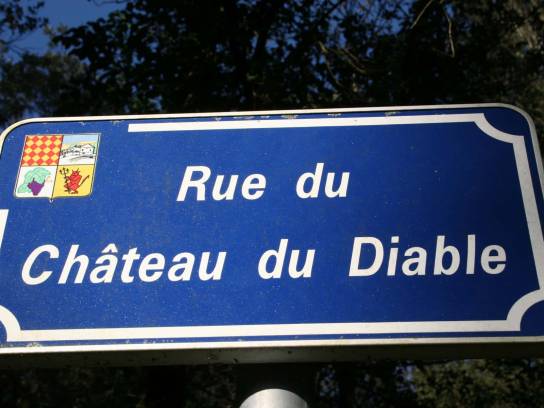
Château du Diable
-
 Photo creditPatrick JanicekLicenseCC BY 2.0
-
 LicensePublic domain
-
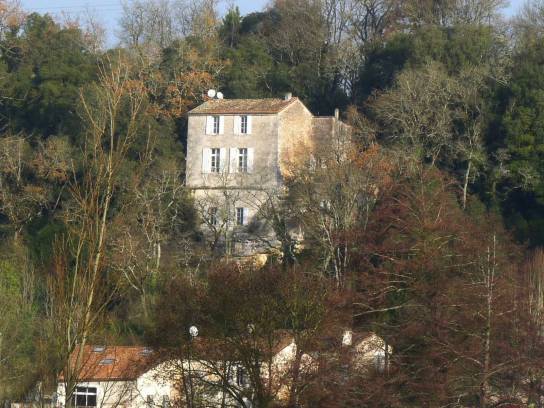 Photo creditJack maLicenseCC BY-SA 3.0
-
 LicensePublic domain


About
The Château du Diable stands on a ridge overlooking the Eaux Claires valley, at the foot of the hamlet of Petit Rochefort. Local tradition holds that it was a former English stronghold during the Hundred Years’ War, hence its name, which is linked to the ‘red devils’, the nickname given to the English. A series of demolitions has profoundly altered the building, which no longer resembles a fortress. Notably, an old vaulted section and the remains of a tower and underground passages are said to still exist. Its gateway, which is much more recent, features two sculptures of devils created in 1937.
A must-see
- The gateway and its two devil sculptures from 1937.
- The silhouette of the castle as seen from the Eaux Claires valley.
- The valley landscape and the limestone hills surrounding the site.
Discover
Introduction
The Château du Diable is a historic and scenic landmark in Puymoyen. Perched on the heights of Petit Rochefort, it commands a commanding view over the Eaux Claires valley. This location partly explains its defensive significance and its prominent presence in the landscape.
The town of Puymoyen traditionally links its history to the Hundred Years’ War: the castle is said to have served as a landmark for the English at that time. The town council also points out that it was demolished several times throughout its history, which explains the discrepancy between its designation as a ‘castle’ and the ruins visible today.
History
The early history of the site remains partly documented by local tradition rather than by detailed historical records. It is therefore advisable to treat the hypothesis of an English stronghold during the Hundred Years’ War with caution.
Local heritage sources indicate that part of a 16th-century residence may still survive, notably in the form of a vast hall covered by a broken barrel vault. This layout is similar to the ‘manoirs-salles’ (hall houses) once common in Angoumois and Gascony.
The present gateway dates from a much more recent period: two sculptures depicting devils were added to it in 1937 by the owner at the time, Mr Boeglen. They have become one of the site’s most recognisable features.
Timeline
- Middle Ages / Hundred Years’ War: the site is traditionally associated with a former English stronghold.
- 16th century: part of the house that survives today dates from this period.
- Over the centuries: several demolitions have profoundly altered the complex.
- 1937: Mr Boeglen added the devil sculptures to the gateway.
- Today: the castle remains a private property and can mainly be viewed from the surrounding paths and countryside.
Architecture & heritage
The architectural interest of the Château du Diable lies less in a preserved monumental complex than in the survival of a few ancient features associated with its defensive layout.
The room with a broken barrel vault, believed to date from the 16th-century residence, is the most characteristic architectural feature mentioned in the sources. The site is also associated with the remains of a tower and underground passages, but their condition and accessibility are not documented in sufficient detail to make them part of a guided tour.
Notable works / features
The two sculptures of devils placed on the pillars of the gateway are the most immediately recognisable features. Created in 1937, they play on the name of the place and give the gateway its distinctive appearance.
However, these sculptures should be distinguished from the site’s supposed medieval heritage: they date from the 20th century and are therefore not a remnant of the Hundred Years’ War.
Did you know?
The name ‘Château du Diable’ is not merely linked to a fantastical legend. Local tradition holds that it refers to the English who were present in the region during the Hundred Years’ War, who were then nicknamed the ‘red devils’. This explanation, however, should be regarded as local tradition rather than a definitively established historical fact.
Explore
Guided tour
- Head towards Petit Rochefort.
The hamlet offers a good vantage point from which to take in the landscape. The château overlooks the surrounding area from the ridge. - Take a look at the gate.
The two sculptures of devils are the site’s most immediately recognisable features. They date from 1937. - Look at the castle from the valley.
The light-coloured façade stands out against the wooded landscape of the Eaux Claires slopes. - Interpret the landscape rather than looking for an intact fortress.
Successive demolitions have caused much of the original complex to disappear. The topography, the commanding position and the surviving remains nevertheless allow us to understand its layout. - Continue towards the Eaux Claires valley.
The castle comes into its own when viewed within this setting of limestone cliffs, woodland and ancient features linked to human activity.
Look here
From the valley, note the relationship between the castle and the topography: the building stands on a ridge and looks directly down onto the Eaux Claires. This position remains one of the site’s main scenic attractions to this day.
Then / Now
The contrast is particularly striking: the site is traditionally presented as an ancient stronghold, whilst the modern-day visitor perceives it primarily as a remodelled complex, whose silhouette is dominated by a few ruins and the ‘Devil’s Gate’.
The valley helps to explain this transformation: the castle is no longer merely a defensive site, but an integral part of the Eaux Claires landscape.
Hidden detail
The site’s true ‘hidden detail’ is perhaps less spectacular than the sculptures on the gateway: it is the relationship between the castle and the terrain. Its position on the ridge helps us understand why this spot could have been a strategic location.
Surroundings
The Château du Diable forms part of the landscape of the Eaux Claires valley, an area characterised by limestone cliffs, woodland and traces of past human activity. The valley is also a popular spot for walking and rock climbing.
The local council also notes the existence of several cave dwellings studied by the GRAHT, bearing witness to human occupation across different periods.
Nearby
- Petit Rochefort: a hamlet situated on the hillside, notably featuring an old communal well.
- Vallée des Eaux Claires: a natural and scenic area offering a context in which to view the castle within its surroundings.
- Moulin du Verger: a former paper mill situated in the valley.
- Cave dwellings: several caves and ruins bear witness to past settlements in the valley.
Continue the tour
For a comprehensive exploration of Puymoyen’s heritage, the Michel Desprez trail links the Château du Diable with Petit Rochefort, the Vallée des Eaux Claires and the Moulin du Verger. The route takes you gradually from the town’s defensive heritage to its rural, industrial and natural heritage.