Moulin du Verger
-
 Photo credit© PropriétaireLicenseAll rights reserved
-
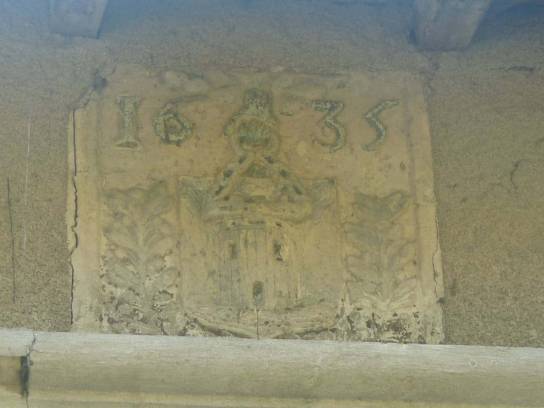 Photo creditJack maLicenseCC BY-SA 3.0
-
 Photo creditJack maLicenseCC BY-SA 3.0
-
 Photo credit© PropriétaireLicenseAll rights reserved
-
 Photo creditJack maLicenseCC BY-SA 3.0
-
 Photo credit© PropriétaireLicenseAll rights reserved
-
 Photo credit© PropriétaireLicenseAll rights reserved


About
The Moulin du Verger is situated in the Eaux Claires valley, south of Angoulême. It forms part of the long history of paper-making in the Charente region: the Heritage Inventory records the first paper-making activity there in 1539, prior to its reconstruction in 1635.
The present building is a particularly representative example of the Charente paper-making tradition. The Ministry of Culture highlights, in particular, its vast drying areas, whose regular openings bear witness to the former scale of production.
The mill is still associated today with the artisanal production of paper and the passing on of papermaking skills. It is set within a natural environment characterised by limestone cliffs and the Eaux Claires valley.
Not to be missed
- The mill buildings and their drying areas;
- The hydraulic system, the sluice gates and the bridge, all included within the historic monument listing;
- The surroundings of the Eaux Claires valley and its limestone cliffs.
Discover
Introduction
The Moulin du Verger is a former paper mill situated in Puymoyen, in the Eaux Claires valley. It stands as a testament to the early development of the paper industry around Angoulême.
Its heritage value lies as much in its architecture as in the continued existence of paper-related activity. The Inventory documents describe it as a complex comprising, in particular, the production workshop, the owner’s accommodation, a drying room and workers’ accommodation.
The valley in which it is situated enhances the experience of the site: local walking routes link the mill to the cliffs, wooded areas and limestone landscapes of the Eaux Claires.
History
The first recorded papermaking activity at the Moulin du Verger dates back to 1539. The Heritage Inventory subsequently notes a reconstruction in 1635, commissioned by Flemish merchants. The Ministry of Culture’s heritage listing, however, cites a major construction phase in the second quarter of the 17th century, dated 1639. This discrepancy in dating may stem from the different methods and documentary sources used in the two listings.
In the 18th century, the mill played a part in the technical developments of the paper industry. The Inventory entry notably mentions trials carried out around 1760 involving the Dutch beater, designed to improve the preparation of paper pulp.
The Charente paper industry at that time benefited from commercial opportunities linked in particular to Atlantic trade and relations with the countries of northern Europe. The Moulin du Verger is one of the most representative examples of this regional industrial history.
Timeline
- 1539 – Paper-making activity documented at the Moulin du Verger.
- 1635 – Reconstruction mentioned in the Heritage Inventory.
- Second quarter of the 17th century – Main construction phase, according to the Historic Monuments entry.
- Around 1760–1761 – Experiments with the Dutch beater.
- Second half of the 19th century – Cardboard production using a round mould machine.
- 29 October 1991 – Listed as a historic monument.
- 2021–2022 – Restoration of the mill and the canal as part of a project supported by the Fondation du Patrimoine.
Architecture & Heritage
The Moulin du Verger is part of our industrial heritage. The workshop is mainly built of rubble stone, with dressed stone, render, exposed timber framing and a long-pitched roof covered with hollow tiles.
One of the most distinctive features is the drying area. The Ministry of Culture highlights the exceptional length of the drying racks and their regular spacing, which reveal the mill’s production capacity.
The 1991 listing covers not only the production workshop and the owner’s residence, but also the sluice gates, the hydraulic system and the bridge.
Notable works / features
Here, the heritage value does not lie in a collection of works of art but in a technical and architectural complex associated with paper-making.
Of particular note are:
- the production workshop;
- the drying room;
- the hydraulic systems;
- the bridge;
- the relationship between the buildings and the river;
- the structures that help to explain the layout of a former paper mill.
Did you know?
The Moulin du Verger is not just a preserved former industrial site: the paper-making tradition is still practised there. It is the last remaining active heir to the Charente’s centuries-old paper-making tradition, with facilities similar to those used before industrialisation.
Explore
Guided tour
- Approach the mill from the valley.
Take the time to observe the relationship between the building, the water and the limestone formations of the Eaux Claires valley. - View the buildings as a means of production.
The layout of the various spaces helps you to understand that this is not simply an old watermill, but a fully-fledged industrial complex dedicated to paper production. - Observe the openings of the drying racks.
Their regular alignment and the length of the drying areas are among the architectural clues to the former importance of production here. - Identify the role of water.
The sluice gates, hydraulic system and bridge are all part of the listed monument. They provide a tangible illustration of the link between hydraulic power and paper-making. - Continue into the valley.
The Puymoyen walking trails allow you to see the mill within a wider context combining built heritage, cliffs and the vegetation of the Eaux Claires.
Look here
- The drying racks: their length and regular openings are particularly revealing of the building’s function.
- The hydraulic system: it serves as a reminder that production was intimately linked to the presence and control of water.
- The cliffs: from the valley paths, they place the mill within its natural landscape.
Yesterday / Today
- Yesterday: the mill was part of a major network of Charente paper mills, whose operations were linked to European trade.
- Today: the site continues to produce paper using traditional methods and also welcomes visitors. In particular, the site features an exhibition gallery and offers guided tours of the mill with the papermaker by appointment.
Hidden detail
The mill preserves the legacy of several generations of papermaking techniques. The Inventory states that in 1669, the site had four water wheels and two vats, giving an idea of the historical technical organisation of production.
Surroundings
The Moulin du Verger is situated in the Eaux Claires valley, an area where industrial and natural heritage are closely intertwined.
The Puymoyen walking trails showcase the valley as a major natural site, notable in particular for its limestone cliffs and biodiversity. The limestone grasslands are home to characteristic flora, whilst the wetter slopes feature ferns and mosses in particular.
Nearby
To continue your exploration in a logical sequence:
- Eaux-Claires Valley – limestone landscapes, cliffs and footpaths.
- Eaux Claires climbing site – situated in the valley.
- Saint-Vincent Church in Puymoyen – a listed historic monument since 1969.
- Petit Rochefort – notably its 16th-century well.
- Château du Diable – another heritage site along the valley route.
Continue the tour
The Chênes Verts trail allows you to explore Puymoyen’s built and natural heritage. It is 6 km long, starting at the Puymoyen village hall, and takes approximately 2 hours to complete. The Moulin du Verger is one of the main points of interest along the route.
Another route, the Michel Desprez trail, is 8.4 km long and takes around 2 hours 50 minutes to complete; it also takes in Saint-Vincent Church, the cliffs, the Moulin du Verger, the nature trail and the valley’s heritage.

Visit
Conditions of visits:
Opening hours
Prices
- Free entry to the exhibition gallery: you are welcome to come and admire the products from the artisan paper mill.
- Guided tour:
- The tour fee is €60 for a group of fewer than 15 people and €4 per person for each additional person (up to 50). Duration: 1 hour 30 minutes. The tour includes a historical overview of the buildings, a description of the entire traditional process of making Occidental paper, and a demonstration.
- On Saturday and Sunday afternoons, by appointment, a more comprehensive presentation (minimum 2 hours) can be arranged, focusing on the history of paper, accompanied by demonstrations and followed by a discussion: €10 per participant – free for children – (minimum group size of eight people).