Jardin Vert
-
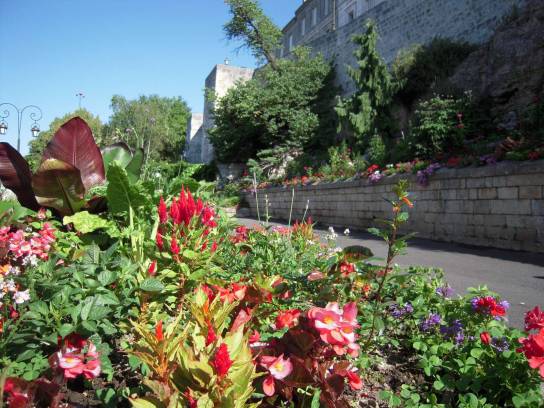 Photo creditPatrick JanicekLicenseCC BY 2.0
-
 Photo creditPatrick JanicekLicenseCC BY 2.0
-
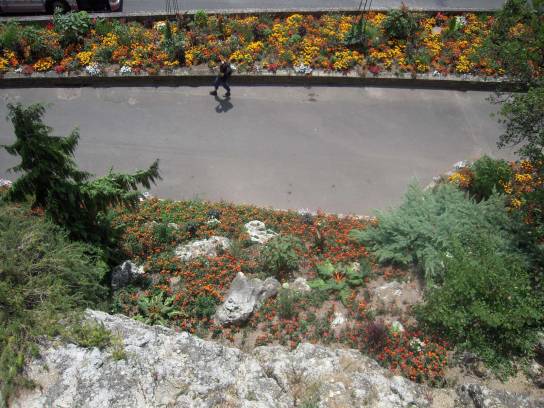 Photo creditPatrick JanicekLicenseCC BY 2.0
-
 Photo creditPatrick JanicekLicenseCC BY 2.0


About
At the foot of Angoulême’s western ramparts, the Jardin Vert is a 19th-century landscaped public garden, laid out on the slopes connecting the upper town to the lower districts. Covering some 4 hectares, its winding paths, trees, flowerbeds and water features create a space for strolling away from the hustle and bustle of the city.
Discover
Introduction
The Jardin Vert is one of the main public green spaces in the centre of Angoulême. It occupies the western slope of the limestone promontory on which the historic town was built. Its location gives it a distinctive layout: rather than a flat, regular garden, it is a sloping park, structured by paths that follow the contours of the land.
Plans to create a promenade beneath the ramparts were first mooted as early as 1835. From 1859 onwards, the public garden project began to take shape, and the landscape architect Louis-Ferdinand Fischer became involved from 1865. Inspired by 19th-century English landscape gardens, he created a setting featuring curves, rockeries, small bridges and water features. An open-air theatre and a Wallace fountain were added to the garden in the 20th century.
Today, the Jardin Vert combines urban greenery, walking paths, relaxation and small elements of landscape heritage. Its appeal lies as much in the presence of trees and flowerbeds as in the way the garden follows the slope of the old ramparts.
Landscapes and natural environments
The landscape of the Jardin Vert is based on three main components:
- The tree-lined slopes: mature trees provide shade and give the park the feel of a garden set against the hillside.
- Flowerbeds and lawns: open spaces alternate with ornamental plantings and footpaths.
- Water features: ponds, old rockeries and decorative elements evoke the park’s historic landscape design. Some features have evolved over time.
The tree species include, in particular, lime trees and horse chestnut trees. Ornamental plantings such as camellias, rhododendrons and azaleas are also mentioned in the planning documents.
The garden is not a wild natural space: it is a maintained urban park, whose ecological value lies in particular in its vegetation cover and the space it provides for nature within the built environment.
Flora and fauna
The Jardin Vert provides a green environment conducive to the presence of small urban wildlife.
Vegetation mentioned in the park’s descriptions:
- Linden and chestnut trees, amongst the ornamental trees.
- Camellias, rhododendrons and azaleas, amongst the ornamental plantings.
- Flowerbeds, lawns and vegetation surrounding the ponds.
The park also features an animal enclosure, home to small domestic animals in particular. As its layout may change, it is best to check what facilities are available at the time of your visit.
Ecological and heritage value
The Jardin Vert is of particular landscape and historical interest. It preserves the legacy of 19th-century public gardens, designed as places for strolling and leisure within towns and cities.
The reference document for the Angoulême Conservation and Enhancement Plan states that the Jardin Vert forms part of the Promenade des Remparts, which is protected as a heritage site. This protection relates to the landscape setting and must be distinguished from an ecological classification such as Natura 2000 or ZNIEFF.
Its ecological value lies in that of a tree-lined urban park: the vegetation provides shade, contributes to thermal comfort and constitutes a green space in the heart of the city.
Things to see and observe
- The winding paths. They follow the slopes and allow visitors to gradually explore the different parts of the garden. Their layout is characteristic of 19th-century landscape design.
- The Wallace Fountain. Installed in 1934, this decorative cast-iron fountain is part of the park’s local heritage.
- The open-air theatre. This outdoor space extends the garden’s role as a venue for social gatherings and cultural events. Performances may be organised here from time to time.
- The ponds and plantings. These reflect the garden’s ornamental layout. Flowerbeds, trees and views through the foliage unfold as you stroll through the garden.
Exploring the site
The Jardin Vert is ideal for a leisurely stroll, with no need to follow a marked route. You can wander along a few paths, sit on a bench or take the time to observe the plantings and the garden’s details.
For a more in-depth exploration, follow a route that connects the park’s entrances to the inner paths, the ponds and the small heritage features. The slope is part of the experience: moving between the different levels may be more challenging than in a flat garden.
The garden is also ideal for a family break, thanks to its playground. The open-air theatre hosts events as per the council’s programme.
Seasonality
- Spring – March to May: A wonderful time to enjoy the reawakening of the vegetation and the ornamental blooms. Weather conditions may make the sloping paths more slippery.
- Summer – June to August: The trees provide welcome shade. The open-air theatre may host shows or events, depending on the season’s programme.
- Autumn – September to November: The changing colours of the foliage give the garden a fresh look. Fallen leaves may make certain parts of the paths slippery.
- Winter – December to February: The park’s layout, the curves of the paths and the topography are more clearly visible when the trees are bare. There are fewer flowers in bloom.
These details reflect the usual seasonal cycles of a landscaped garden. They do not constitute a precise flowering calendar nor a guarantee of specific conditions.
Nearby
These sites allow you to extend your exploration of the Jardin Vert whilst remaining in the centre of Angoulême.
- The ramparts and Place Beaulieu. In the immediate vicinity, above the garden. To discover the relationship between the sloping garden, the fortifications and the historic plateau. Views depend on the vantage points accessible.
- Angoulême Town Hall. In the upper town. An extension into the architectural heritage of the historic centre, notably the medieval towers incorporated into the town hall.
- The Town Hall garden. In the historic centre. A garden of more modest dimensions, worth exploring to compare its formal layout with the sinuous design of the Jardin Vert.
Continue the tour
For an outing focusing on gardens and urban landscapes, start with the paths of the Jardin Vert, then head up towards the Beaulieu ramparts and continue into the upper town. This route takes you from the landscaped garden to the fortifications, before reaching the streets and gardens of the historic centre.
As the climb is uphill, allow extra time if you wish to explore the garden at a leisurely pace or if you are visiting with young children.
Visit

Conditions of visits:
Opening hours
Prices
Equipment and services
- Wheelchair-accessible entrance
- Wheelchair-accessible car park
- Picnic area
- Children's play area