Notre-Dame Church (Fléac)
-
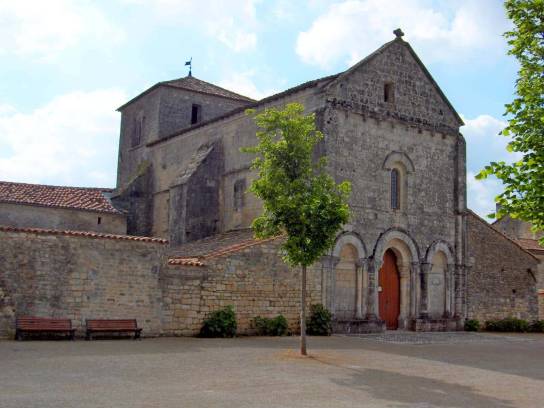 Photo credit2PassageLicenseCC BY-SA 3.0
-
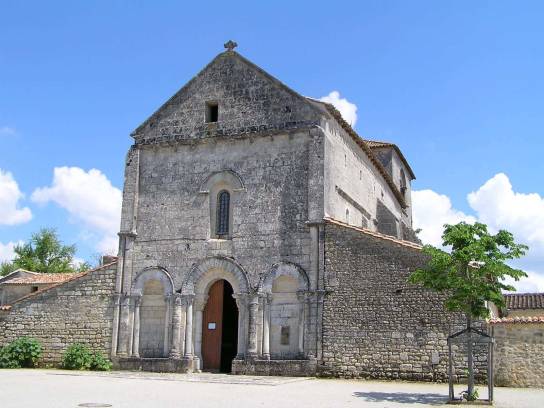 Photo creditRosierLicenseCC BY-SA 3.0
-
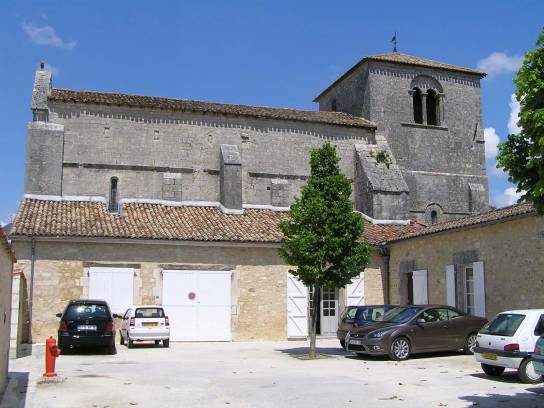 Photo creditRosierLicenseCC BY-SA 3.0


About
The Church of Notre-Dame in Fléac occupies a remarkable position on the hillside overlooking the Charente, facing the Angoulême promontory. Its architecture is typical of the Charente Romanesque style and features one particularly striking characteristic: a row of domes covers the nave, in a layout reminiscent of Saint-Pierre Cathedral in Angoulême.
The building also preserves medieval murals rediscovered during restoration work. Dating from the late Gothic period, they are notably associated with the martyrdom of Saint Barbara.
A must-see
- The row of domes in the nave – an architectural feature characteristic of the Romanesque landscape of the Angoulême region, also found at Saint-Pierre Cathedral in Angoulême.
- The murals in the nave – a medieval cycle, several scenes of which are interpreted as episodes from the martyrdom of Saint Barbara.
- Its relationship with the landscape – the church is situated on a hillside overlooking the Charente valley, facing Angoulême across the landscape.
Discover
Introduction
Notre-Dame Church is one of the buildings that helps us understand the spread of Romanesque architectural styles around Angoulême. Its location on the hillside is not merely a matter of landscape: it places the church within the historic geography of the market town, overlooking the valley.
The interior is particularly interesting for its domed ceiling. This layout is one of the architectural features that links Notre-Dame de Fléac to the great religious architecture of the Angoulême region.
History
The church is linked to the religious history of Angoulême: it originally fell under the jurisdiction of Saint-Cybard Abbey before coming under the authority of the chapter of Angoulême Cathedral from 1110 onwards. Parish records detail several stages of construction: a new church at the end of the 11th century, followed by the construction of the apse and the bay beneath the bell tower in the 12th century, before the nave was vaulted with a row of cupolas around the middle of the 12th century.
The building subsequently underwent various alterations. In particular, the wall paintings were concealed beneath several layers of whitewash before being rediscovered in the 20th century. Their uncovering has helped to better reveal the masonry of the walls and the painted decoration.
The church was listed as a Historic Monument on 11 December 1912. A comprehensive restoration project has, in particular, served to highlight the wall paintings.
Timeline
- 8th century – Notre-Dame de Fléac is mentioned as a dependency of Saint-Cybard Abbey.
- Late 11th century – Construction of a new church with a nave that was originally timber-framed.
- 1110 – The church came under the jurisdiction of the chapter of Angoulême Cathedral.
- 1125–1130 – Construction of the apse and the bay beneath the bell tower.
- 1125–1140 – The façade carvings were completed.
- Around 1140 – The nave was vaulted with a row of domes.
- Late 15th century – The murals were painted and the bell tower was rebuilt.
- 17th century – Reconstruction of the massive buttresses.
- 1912 – The church was listed as a historic monument.
- 1991 and 2003 – Restoration programmes for the murals.
Architecture & Heritage
The church is a fine example of Romanesque architecture in the Angoumois region. Its most distinctive feature is the nave’s roof, which consists of a series of domes. This design, also found at Saint-Pierre Cathedral in Angoulême, is a key feature of local religious architecture.
The documentation on the building also highlights sculpted decoration on the façade, notably modillions depicting human and animal figures.
Its location on a steeply sloping site is also worth noting: the chancel follows the contours of the hillside as it descends towards the Charente. This interplay between architecture, topography and landscape contributes to the uniqueness of the visit.
Notable works / features
The murals in the nave are the main artistic feature to look out for inside.
The Ministry of Culture dates them to the 14th century and describes, in particular, a scene of martyrdom identified as that of Saint Barbara. The cycle is read from right to left on the south wall of the second bay. Other fragments bear witness to the existence of a more extensive painted decoration in the nave.
Local tradition strongly associates Fléac with the cult of Saint Barbara. A chapel dedicated to the saint existed in the village as early as the 15th century, and the pilgrimage was still active at the beginning of the 20th century.
Did you know?
The Church of Notre-Dame and Saint-Pierre Cathedral in Angoulême face each other on either side of the Charente valley. They also share a remarkable architectural similarity in the use of a row of domes in their naves.
Explore
Guided tour
- Start with the site itself.
Before entering, take a moment to note the church’s position on the hillside. The Charente valley lies below, whilst Angoulême is situated on the opposite promontory. - Look at the façade.
Take the time to observe the portal, the arcades and the corbels. The sculpted decoration is entirely in keeping with the building’s Romanesque style. - Step inside and look up.
The succession of domes is immediately apparent. Notice their rhythm and the way they structure the nave. - Look out for the murals.
On the south wall of the nave, observe the surviving scenes from the cycle depicting the martyrdom of Saint Barbara. Some parts are clearer than others due to their state of preservation. - Step back outside.
From the church’s surroundings, view the building within its landscape: the hillside, the Charente river and the Angoulême promontory form a striking scenic backdrop.
Look here
- In the nave: the regular rhythm of the domes.
- On the south wall: the murals depicting the martyrdom of Saint Barbara.
- On the façade: the sculpted elements and modillions.
- From the surroundings: the visual connection between Fléac and Angoulême.
Yesterday / Today
The murals had been covered with several layers of whitewash, applied regularly from the 17th century onwards, according to the local council. Their rediscovery and subsequent restoration have profoundly transformed the way the building’s interior is perceived.
Hidden detail
Don’t just look at the paintings. Take the time to scan the sculpted parts of the façade as well: the corbels and capitals contribute to the overall interpretation of the church as a whole, where architecture and sculpture are closely intertwined.
Surroundings
The church is adjoining the former deanery. The town’s heritage trail highlights this building as a key part of exploring the site: it dates from the 12th and 13th centuries and notably features a vaulted hall with an internal well and arrow slits.
Fléac’s location also makes it possible to combine a visit to the church with an exploration of the Charente countryside. The village is situated on a hillside overlooking the river, facing the Angoulême promontory.
Nearby
In the village of Fléac, your exploration can continue to:
- The deanery, which is directly adjacent to the church and features medieval architectural elements.
- Fléac Castle, a 19th-century building now owned by the local council.
- The Logis de Chalonne, linked to the history of the Montgeon and Montalembert families.
- The landscapes of the Charente Valley, which form the village’s immediate natural setting.
Continue the tour
A good way to extend your exploration is to walk through the village, starting from the church, and then visit the heritage sites marked on the local walking trails. This approach helps you understand the connection between the church, the historic houses and the hillside landscape.

Visit
Conditions of visits:
Opening hours
Prices
Equipment and services
- Wheelchair-accessible entrance
- Wheelchair-accessible car park