St. Andrew's Church
-
 Photo creditJLPCLicenseCC BY-SA 3.0
-
 Photo creditCobber17LicenseCC BY 3.0
-
 Photo creditJLPCLicenseCC BY-SA 3.0
-
 Photo creditJLPCLicenseCC BY-SA 3.0
-
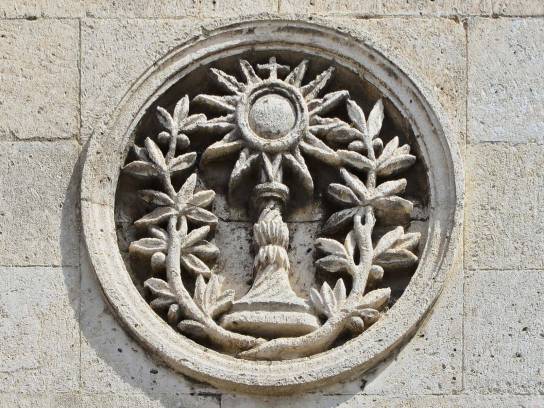 Photo creditJLPCLicenseCC BY-SA 3.0
-
 Photo creditJack maLicenseCC BY-SA 3.0
-
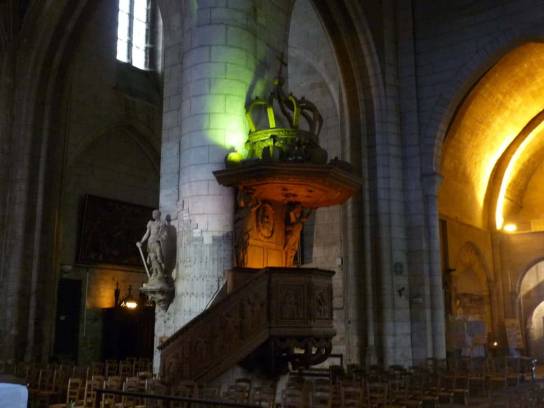 Photo creditJack maLicenseCC BY-SA 3.0
-
 Photo creditJack maLicenseCC BY-SA 3.0
-
 Photo creditJLPCLicenseCC BY-SA 3.0
-
 Photo creditJLPCLicenseCC BY-SA 3.0
-
 Photo creditJLPCLicenseCC BY-SA 3.0
-
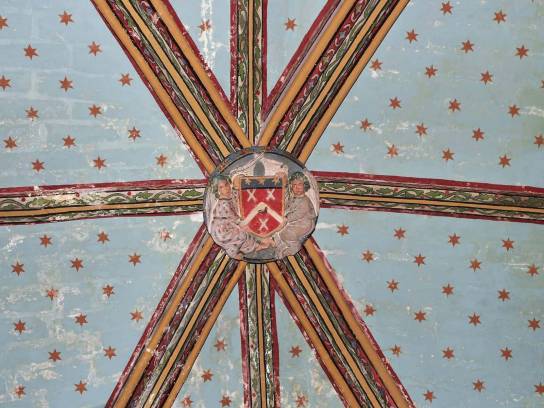 Photo creditJLPCLicenseCC BY-SA 3.0
-
 Photo creditJLPCLicenseCC BY-SA 3.0


About
Saint-André Church is one of the oldest religious buildings in the historic centre of Angoulême. Its history is reflected in the juxtaposition of several construction phases: a 12th-century Romanesque narthex, an eastern section remodelled in the late Middle Ages, alterations linked to the Wars of Religion, and a Neoclassical façade built in the 19th century.
The present-day building thus preserves several layers of the town’s religious and architectural history. The Romanesque section, the Gothic elements, the bell tower and the façade dating from 1825 form a complex that is particularly striking when viewed from Rue Taillefer.
A must-see
- The Romanesque narthex, comprising three bays and characterised by its blind arcades.
- The passageway between the Romanesque and Gothic sections, which illustrates the building’s successive transformations.
- The Neoclassical façade dating from 1825, designed by Paul Abadie the Elder.
Discover
A church shaped by several centuries
The first Saint-André church is recorded as dating from 1020. In that year, Guillaume II, Count of Angoulême, donated the church to Saint-Amand Abbey in Boixe, which established a priory there. However, the building from that period has not survived.
A new church was built in the 12th century. Three bays of this Romanesque church remain in the present-day building and form the front part of the nave. The side walls feature blind pointed-arch arcades resting on clusters of three columns. Some carved elements, probably from parts that have since been lost, have also been reused.
At the end of the 15th century, the eastern section underwent a major transformation. It took the form of a three-nave church, giving the building a largely Gothic layout. Two chapels were added to the side aisles at the beginning of the 16th century.
The Wars of Religion and the Reconstruction
In 1568, during the religious unrest that affected Angoulême, the church’s vaults were demolished, with the exception of the one beneath the bell tower. Their reconstruction took place gradually and was not completed until 1668.
This history partly explains the building’s eclectic appearance: the church is not the result of a single architectural project, but rather the layering of several periods of construction, destruction and restoration.
The 19th-century transformation
A gallery was installed behind the façade in 1821. A few years later, in 1825, Paul Abadie the Elder designed a new façade in the Neoclassical style. This work gave the church its current external appearance on Rue Taillefer.
The contrast between this 19th-century façade and the preserved medieval elements inside is one of the main architectural highlights of the visit.
Timeline
- 1020: William II, Count of Angoulême, donated the church to Saint-Amand Abbey in Boixe, which established a priory there.
- 12th century: Reconstruction of the church. The present Romanesque narthex dates from this period.
- Late 15th century: Reconstruction of the eastern section as a three-nave church.
- Early 16th century: Two chapels were built in the side aisles.
- 1568: The vaults were destroyed during the Wars of Religion, with the exception of the one beneath the bell tower.
- 1668: The vaults were finally restored.
- 1821: Installation of a gallery at the rear of the façade.
- 1825: Construction of the neoclassical façade by Paul Abadie the Elder.
- 1951: The church was listed as a historic monument.
Architecture and heritage
The church offers a particularly interesting insight into the evolution of religious architecture in Angoulême.
The Romanesque narthex is the oldest surviving part. Its blind arcades, grouped columns and broken barrel vault are characteristic of 12th-century medieval architecture.
The eastern section, comprising a nave and side aisles, dates from a later phase. Its layout bears witness to the alterations undertaken in the late 15th century.
The bell tower is distinguished by its two storeys separated by string courses. Its windows feature moulded jambs in the form of small columns, an architectural detail best observed from the surroundings of the church.
Finally, the Neoclassical façade dating from 1825 introduces a different aesthetic, characteristic of the work of Paul Abadie the Elder.
Notable works and features
The church retains a collection of antique furnishings, including in particular:
- a pulpit and an altarpiece dating from the 17th century;
- 18th-century organs;
- several paintings from the 16th, 17th and 18th centuries.
Several items of furnishings are also protected as historic monuments, notably the pulpit, the high altarpiece, paintings, sculptures, the organ and a bell.
Did you know?
Saint-André Church does not display a uniform architectural style corresponding to a single period. Three centuries of construction and alteration are clearly evident in its structure: the 12th-century Romanesque style, the Gothic alterations of the late Middle Ages and the 19th-century Neoclassical façade.
Explore
Guided tour
- Start at Rue Taillefer
Take a look at the façade before going inside. Its neoclassical style contrasts with the church’s age and serves as a reminder that the building underwent further major alterations in the 19th century. - Step inside the church and look for the break between the different sections
The older part and the eastern section were not built as part of the same construction phase. This transition is one of the best ways to understand the monument. - Take a look at the Romanesque narthex
Look at the side walls and their blind arcades. The clusters of three columns are a characteristic feature of this 12th-century section. - Look up at the vaults
Their history is linked to the destruction of 1568 and their reconstruction, which was completed in 1668. They therefore also bear witness to the building’s eventful history. - Look out for reused sculpted elements
Some sculpted motifs have been set into the wall separating the Romanesque structure from the Gothic section. They probably originate from parts of the building that no longer exist. - Take the time to look at the furnishings
The pulpit, the altarpiece, the organ and the paintings allow you to extend your exploration of the architecture by discovering the church’s artistic history.
Look here
- The blind arcades. In the narthex, they are a particularly interesting architectural feature for identifying the Romanesque section.
- The bell tower. From the outside, note its two storeys, the string courses separating them and the windows framed by small columns.
- The façade dating from 1825. It bears witness to the architectural renewal of the 19th century and allows you to appreciate the stylistic contrast with the medieval sections.
The hidden detail
Look closely at the wall separating the Romanesque narthex from the Gothic structure: carved elements, probably from parts that have since been lost, have been reused here. These fragments offer a subtle trace of the monument’s successive transformations.
Then / Now
The present-day church is the result of a long series of alterations. The 12th-century building was partially replaced at the end of the 15th century, damaged in 1568, restored in the 17th century, and then given a new façade in the 19th century. A visit thus allows you to directly trace several periods in Angoulême’s history within a single building.
The church in the town
Saint-André is situated in the historic centre of Angoulême, on the plateau. This area is home to a significant proportion of the town’s remarkable heritage, within an urban fabric characterised by the age of the centre, its religious buildings and its ancient defensive structures. Angoulême’s heritage report emphasises that the historic plateau is home to the majority of the town’s notable monuments.
Nearby
Your visit can be extended with a walking tour of Angoulême’s historic centre, particularly around:
- Saint-Pierre Cathedral;
- The city walls and ramparts;
- Notre-Dame d’Obézine Church;
- Saint-Martial Church;
- The old streets of the plateau.
These buildings form part of a particularly rich heritage complex in the upper town.
Continue the tour
To fully appreciate Saint-André, the best thing to do is to continue your exploration towards Saint-Pierre Cathedral and the ramparts. This route allows you to compare different periods of religious architecture and to situate the church within the historical fabric of the Angoulême plateau.

Visit

Conditions of visits:
Opening hours
The church is open every day.
Prices
Equipment and services
- Wheelchair-accessible entrance
- Wheelchair-accessible car park