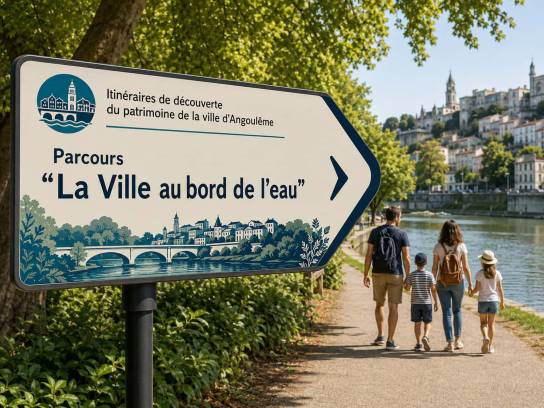
"The City by the River" Tour
The “The City by the River” walking tour in Angoulême offers visitors the chance to discover a lesser-known aspect of the city: its historical relationship with the Charente River. Unlike the upper town, built for defense and power, the riverbanks have long been a hub of economic activity, with ports, mills, and workshops that contributed to Angoulême’s development.
This walking tour highlights the importance of the Charente River in the city’s history while offering a peaceful setting where heritage, nature, and scenery come together. It provides a better understanding of how Angoulême developed around its river and invites visitors to rediscover a calmer, greener side of the city.
Tracé du parcours de randonnée
Départ / Arrivée du parcours
 Itinéraire à télécharger (format GPX)
Points of interest to see along the way
- Bird's-Eye View - The Historic Districts of Angoulême
This bird's-eye view, created by illustrator Bruno David in June 2009, offers a fresh perspective on the city. - City Hall
Formerly the castle of the Counts of Angoulême, City Hall was rebuilt by Paul Abadie in 1858, preserving two medieval towers that bear witness to the city’s rich historical past. - Hôtel Saint-Simon
Built between 1530 and 1550, this monument exemplifies the early French Renaissance with its façade adorned with medallions, shells, and geometric motifs. Its irregular layout reflects the dense fabric of the medieval Saint-André district. - Saint-André Church
Marked by the Hundred Years’ War and the Wars of Religion, this church, restored in the 17th century, blends several architectural styles. Its furnishings, the remains of the Taillefer Palace, and a Romantic trompe-l’œil titled “Memories of the 20th Heaven” enrich the site. - Place Francis Louvel
Built on the site of a former convent destroyed after the Wars of Religion, this square has been home since the 19th century to the Palais de Justice, inspired by an ancient temple, and a fountain installed in 1833. - Place du Général Resnier
Guillaume Resnier de Goué, born in Angoulême in 1729, a military officer and inventor, conducted flight tests with a flying machine of his own design, including a feat of flying more than 300 meters above the Charente River from the Beaulieu rampart. - Jardin Vert
Created in 1860 by landscape architect Fisher, this 4-hectare park occupies the former glacis of the ramparts. At the foot of the northern rampart lies the grotto where the hermit Saint Cybard lived until 581. - Paper Museum
Housed in the former Joseph Bardou-Le Nil paper mill, built over the Charente River, the Paper Museum occupies a remarkable bridge-building that was renovated in 1987 and is shared with the European School of Visual Arts. - Möbius Vessel
Designed by Roland Castro in 1985 on the former site of Saint-Cybard Abbey, this futuristic building houses the Cité de la BD, a symbol of Angoulême’s development as the capital of visual arts and comics. - Hugo Pratt Footbridge
At 190 meters long, this pedestrian and bicycle bridge connects the buildings of the Cité de la BD to Île Marquet. It offers a view of the Charente River and the old wine cellars, as well as access to a nature trail. - Comic Book Museum
Housed since 2009 in former wine cellars, the Comic Book Museum traces the history of the “9th art,” its techniques, its aesthetics, and manga, featuring reading areas and audiovisual exhibits. - Alsatian House and Château de Dampierre
As early as the 19th century, factories lined the banks of the Charente River. The riverfront still bears the mark of Lazare Weiller, an Alsatian industrialist, who had an Alsatian-style house built near the Château de Dampierre and the former wine cellars dating from 1857. - Place Mulac
Dedicated to Auguste Mulac, this square is home to Saint-Cybard church, built in 1867 in the Neo-Romanesque style. Brimming with activity thanks to its markets, schools, and monthly flea market, it remains a vibrant hub of the neighborhood. - Workers’ Housing in Saint-Cybard
The industrial neighborhoods of Saint-Cybard and L’Houmeau still feature workers’ houses with gardens, built in the 19th century near the factories. They stand alongside the more affluent homes of former industrialists. - Bourgine Island
Formerly owned by Saint-Cybard Abbey, Bourgine Island owes its name to Dominique Bourgine, who established a bathhouse there in 1852. The municipal swimming pool built in 1959 no longer exists. - Port l’Houmeau
Founded in 1280, the port of Angoulême remained active until the arrival of the railroad in 1853. Now used for recreational purposes, it stands next to the Capitainerie, a former 18th-century mansion. - Saint-Jacques Church
Rebuilt around 1840 by Paul Abadie Sr., this neoclassical church replaced a Romanesque structure. Restored after the bombings of 1944, it now stands at the heart of a lively, welcoming shopping square. - Regional Contemporary Art Fund (FRAC)
Designed by Jean-Marie Mandon, the FRAC Poitou-Charentes combines steel, glass, and concrete in a light-filled structure that opens onto the Charente River. This contemporary building is part of the renovation of the Houmeau neighborhood. - Jardin des Villes Jumelées
Overlooking the Charente River, this garden offers a remarkable panoramic view of Angoulême. Located near the Maison des Jumelages, it stands on the site of a former city gate that once welcomed distinguished visitors. - Le Châtelet - Les Halles
Built in 1887 on the site of a former royal castle, the market halls designed by Warin were inspired by Baltard. Restored in 2000, they stand next to the mural “La fille des remparts.”
Itinerary
Follow the route clockwise.
The main stops along the route.
The route forms a loop that can be divided into three main sections:
- The descent from the Plateau to the riverbanks: the route typically begins in the historic center (Rue de l’Arsenal). You’ll first walk along the northern ramparts, which offer a panoramic view down into the river valley. You’ll then descend through the Jardin Vert, a shaded public park that winds along the base of the cliff.
- The river loop and the Vallée de l’Image: once you reach the bottom, you cross the river to reach the Cité Internationale de la Bande Dessinée. The route takes you across the famous Hugo Pratt footbridge (adorned with a statue of Corto Maltese) to connect the Vaisseau Mœbius to the former Chais Magelis. You’ll then walk along the Quai Besson Bey and the lush riverbanks that inspired Honoré de Balzac for his novel *Lost Illusions*.
- The Houmeau neighborhood and the climb back up: the trail passes through the former Port de l’Houmeau, once the heart of the city’s commercial activity. The return to the upper town takes you along steeper paths, picturesque alleyways, and stairways that lead you directly back to the plateau.
Elevation change: The route includes a significant descent and ascent. Be sure to wear sturdy walking shoes for the stairs and steep sections.
Nature alternative: If you’d like to extend your walk along the water, the riverbanks also connect to the Coulée Verte, a former towpath that’s ideal for a completely flat hike in the shade of the trees.
Excerpt from the guide map “Heritage Discovery Routes of the City of Angoulême.”
Place Bouillaud
16000 Angoulême
France
-
 Crédit photoIndia AlphaLicenseFree Art License

Conseils pratiques et recommandations
Pour rendre votre randonnée agréable
- Ne surévaluez pas vos forces physiques.
- Renseignez vous sur le temps de parcours, sur la météo.
- Évitez de partir seul.
- Emportez une gourde d’eau, une trousse à pharmacie, une carte IGN, une boussole.
- Soyez équipé d’un sac à dos, de chaussures de marche, d’un vêtement chaud, d’un vêtement de pluie, d’un chapeau.