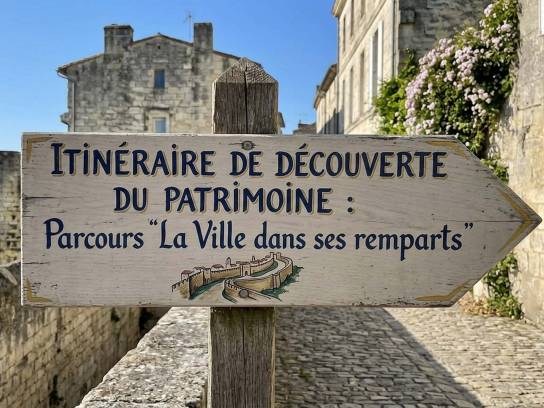
"The City Within Its Ramparts" Tour
The “The City Within Its Ramparts” trail in Angoulême is a beautiful 4.5-kilometer walk that takes about 2 hours to complete. This route takes you around Angoulême’s historic plateau, overlooking the Charente Valley. It offers a unique panoramic view of the surrounding landscapes and allows you to discover the city’s rich fortified heritage. Enameled lava stone plaques are placed along the route to tell the story of the area.
Tracé du parcours de randonnée
Départ / Arrivée du parcours
 Itinéraire à télécharger (format GPX)
Points of interest to see along the way
- The Historic Districts of Angoulême
This bird’s-eye view, illustrated by Bruno David, offers a unique perspective on Angoulême’s historic districts. It highlights the routes through the city center and along the ramparts, while also introducing visitors to the waterfront area. - City Hall - Former Castle of the Counts of Angoulême
Converted into city hall in 1858 by architect Paul Abadie Jr., the former castle of the Counts of Angoulême retains two medieval towers: a 13th-century polygonal tower and a 15th-century round tower. This monument embodies both the city’s prestigious countly past and its architectural revival in the 19th century. - Hôtel Saint-Simon
Built between 1530 and 1550, the Hôtel Saint-Simon exemplifies the architecture of the early French Renaissance. Its façade is distinguished by its geometric motifs, medallions inspired by antiquity, and sculpted shells. Its irregular layout is due to its location in the medieval Saint-André district, which was already densely built-up. - Le Châtelet - Les Halles
Formerly the site of a royal castle built around 1250, later a prison and the headquarters of the municipal police, the site has housed market halls inspired by Victor Baltard’s design since 1887. Designed by architect Warin and restored in 2000, they line the old ramparts, where the mural “La fille des remparts” can be seen. - Place du Palet
In the heart of the city, this square once hosted one of Angoulême’s main markets, featuring a large market hall dedicated primarily to butchers and haberdashers. It opened onto the Porte du Palet, a major entrance to the fortified city. Its name recalls the “pal” that once stood here, associated with the execution of condemned prisoners. - Saint-André Church
Scarred by the destruction of the Hundred Years’ War and the Wars of Religion, Saint-André Church was restored in the 17th century and today features architecture with a variety of influences. It houses a rich collection of furnishings. In the nearby square, discover the remains of a chimney from the Taillefer Palace and a wall painted with a romantic trompe-l’œil scene titled “Memories of the 20th Heaven.” - Place Francis Louvel
Built on the site of a former convent destroyed after the Wars of Religion, this square retains the open space created during that period. In the 1820s, the Palais de Justice, designed by Paul Abadie Sr., was built here in a style inspired by ancient temples. Its fountain, installed in 1833, adds to the elegance of the site. - Place du Minage
The name of this square evokes the “mine,” an ancient unit of measurement used for the sale of grain and the collection of taxes. It thus recalls its historical role as a grain market, where one of the city’s three market halls once stood—built in the 15th century and later demolished in the 19th century. Its square and fountain, inaugurated in 1869, bear witness to its redevelopment. - Former Carmelite Convent
Settled in Beaulieu in 1653, the Carmelites—a contemplative women’s religious order—occupied a convent that was gradually formed through the acquisition of private homes in the 17th and 18th centuries. Two Baroque gateways from this complex remain today, visible on Rue Turenne and Place Turenne, bearing witness to the neighborhood’s religious history. - Rue de Beaulieu
Once a major thoroughfare of the city, Rue de Beaulieu formerly connected two city gates. Away from the hustle and bustle of the city, the Cordeliers founded their convent there in the 13th century. Its chapel, recognizable by its stone spire, is one of the few remaining examples of Angoumois Gothic architecture. Also worth exploring: the 19th-century Hôtel-Dieu and the Hôtel de Bardines. - Place Beaulieu
Built on the site of the old ramparts that were razed in the 17th century, Place Beaulieu now offers a pleasant, tree-lined promenade. It charms visitors with its views of the Jardin Vert and the Charente Valley. Nearby, the Lycée Guez de Balzac stands on the site of a former Benedictine abbey founded in the 11th century. - Saint-Pierre Cathedral
A masterpiece of Romanesque art, Saint-Pierre Cathedral sets Angoulême apart with its unique architecture, distinct from the great French Gothic cathedrals. Built in the early 12th century, it captivates visitors with its richly sculpted façade and its nave covered with rows of cupolas, characteristic of the Romanesque style of southwestern France. - Former Bishop’s Palace – Museum
Built in the 12th century near the cathedral, the former bishop’s palace underwent several transformations from the 15th to the 19th century. It has housed the municipal museum since 1920. Renovated between 2005 and 2008, it features three major collections: Charente archaeology, African and Oceanic arts, and fine arts. - Panoramic View from the Carnot Statue
From this lookout point, admire the Anguienne Valley, the Ma Campagne neighborhood, and its iconic towers. The view extends all the way to the golf course, at the edge of the Bois Saint-Martin. Erected in 1897 by Raoul Verlet in honor of President Sadi Carnot, the statue overlooks the access ramps to the upper town and offers a remarkable view of Angoulême. - Prefecture
Built in 1832 by architect Paul Abadie Sr., the prefecture stands south of the former park of the count’s castle. Its neoclassical architecture, sober and imposing, reflects the desire to assert the presence of the state. Since 1790, Angoulême—having become the capital of the Charente—has thus been equipping itself with buildings befitting its new status. - Rue de Belat
This street runs along the site of the former ramparts that protected the castle of the Counts of Angoulême. Reinforced in the 16th century with a bastioned enclosure built by the engineer Ramelli for the Duke of Épernon, it still features one of the two watchtowers that remain visible today. The Protestant church, built in the 19th century, rounds out the heritage of this historic street. - Eastern Rampart
As you walk along Angoulême’s ancient ramparts, enjoy remarkable panoramic views of the city and its surroundings. From the Eastern Rampart, admire the Obezine Chapel and its slender stone spire, a Neo-Gothic masterpiece from the early 20th century. Nearby, you can also explore the Charente Archaeological and Historical Museum. - Champ de Mars
Once a defensive area to the east of the fortified city, the Champ de Mars stood on the site of the old moats and walls. Later transformed into a fairground and then a popular gathering place, it has hosted festivals, celebrations, and events for centuries. Redesigned by architect Alexandre Chemetoff, it was inaugurated in its new configuration in 2008. - Saint-Martial Church
Located in the heart of the former Saint-Martial suburb, this Neo-Medieval church was built in the mid-19th century by architect Paul Abadie. Built on the site of a former Romanesque church and its cemetery, it is distinguished by its imposing bell tower and porch and bears witness to the neighborhood’s transformations in the 19th and 20th centuries. - Place Marengo
In the heart of the main pedestrian street, Place Marengo is dominated by the Caisse d’Épargne building, recognizable by its slate dome, which was inaugurated in 1912 on the site of part of the former Ursuline convent. In the center of the square, a bust of Hergé, installed in 2003, pays tribute to the creator of Tintin.
Itinerary
Follow the route clockwise.
- After exploring the City Hall garden, leave it by walking past the statue of Marguerite d'Angoulême.
- Then head to Rue de la Cloche Verte, behind the Quick restaurant. At No. 15 stands the Hôtel Saint-Simon.
- Then retrace your steps and turn left onto Rue de Genève to reach Les Halles.
- Cross Rue du Chat, then turn left onto Boulevard Pasteur. At the end of the boulevard, turn left onto Place du Palet, then right onto Rue Raymond Audour.
- Continue along Rue des Trois Notre-Dame before entering Passage Saint-André. Then turn right onto Rue Saint-André and cross Place Francis Louvel.
- Continue along Rue de Beaulieu, then Rue Vauban, before turning left onto Rue Froide. At the end of this street, turn onto Rue de Turenne, then take Rue Bouillaud, Rue Balzac, Rue François Ier, and Rue Jean Guérin in that order.
- Return to Rue de Beaulieu, then head toward Boulevard des Anciens Combattants. Turn left at the statue of Marguerite d’Angoulême, where a U-turn will take you back toward the Midi rampart.
- Continue on to Place Saint-Pierre. Turn right, then immediately right again, before reaching the Desaix rampart. Next, take Rue Corneille, then Rue d’Arc, before returning to the rampart.
- Continue straight ahead on Boulevard Jean et Jérôme Tharaud, then cross the street into Rue de Belat. At the watchtower, turn around to enjoy the view, then head toward Boulevard Émile-Roux.
- When you reach the prefecture, turn around and continue along the ramparts. Turn right onto the eastern rampart, then left onto Rue de Montmoreau.
- The route continues along Rue René-Goscinny, Rue Louis Barthou, and Rue Jean Fougerat, before returning to Rue de Montmoreau. Finally, turn right onto Rue Hergé, then left onto Rue de l’Arsenal, where this stage of your exploration of the city within its ramparts comes to an end.
Excerpt from the guide map “Heritage Discovery Routes in the City of Angoulême.”
Type of itinerary
Loop
Difficulty
Easy
Distance of the circuit
4,3 km
Estimated hiking time
2 hr
Beaconing
No
Start of the hike
Place Bouillaud
16000 Angoulême
France
-
 Crédit photoIndia AlphaLicenseFree Art License

Conseils pratiques et recommandations
Pour rendre votre randonnée agréable
- Ne surévaluez pas vos forces physiques.
- Renseignez vous sur le temps de parcours, sur la météo.
- Évitez de partir seul.
- Emportez une gourde d’eau, une trousse à pharmacie, une carte IGN, une boussole.
- Soyez équipé d’un sac à dos, de chaussures de marche, d’un vêtement chaud, d’un vêtement de pluie, d’un chapeau.
Météo